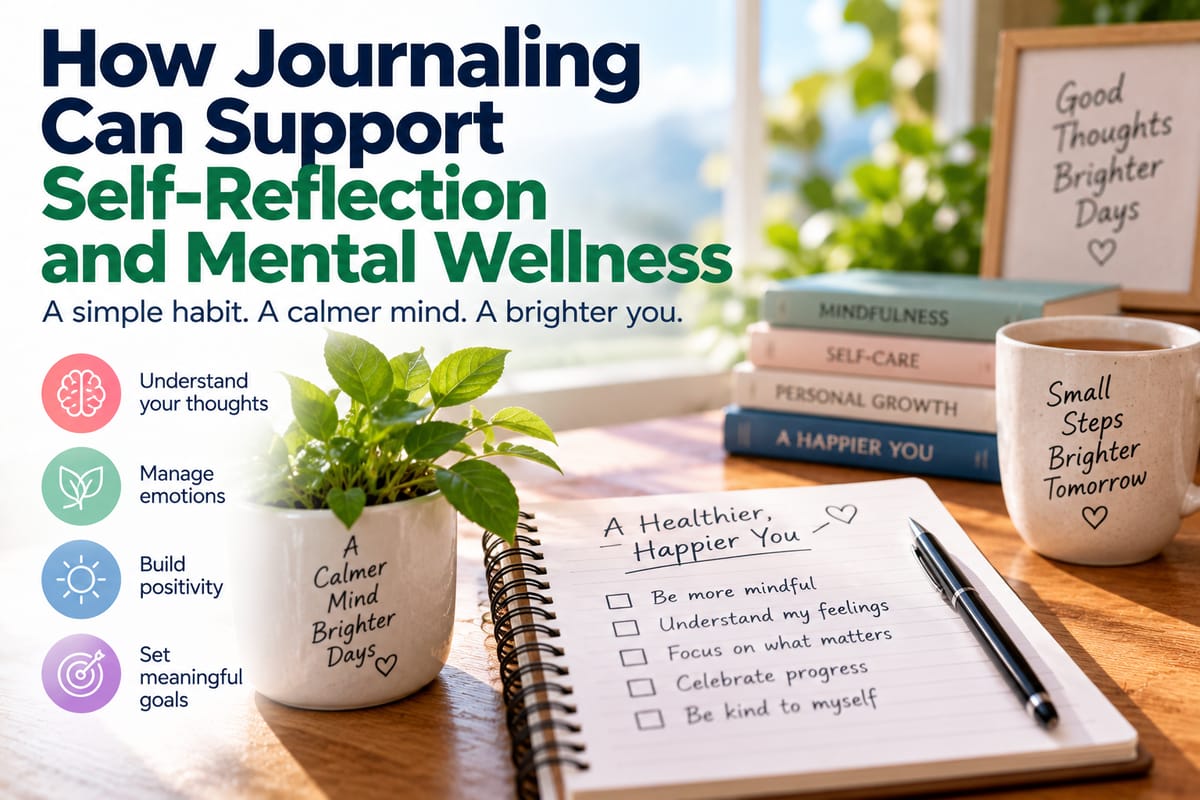

How Journaling Can Support Self-Reflection and Mental Wellness
Journaling is one of the simplest ways to create space for thoughts, emotions, experiences, and personal goals. It requires little more than a notebook and a few minutes, yet the practice can encourage people to slow down and pay closer attention to what is happening in their inner lives.
For some people, journaling means writing freely about the day. For others, it may involve answering specific questions, recording gratitude, tracking emotions, reflecting on difficult experiences, or planning future goals.
The value of journaling does not come from writing perfectly. It comes from creating an opportunity to pause, observe, and make sense of experiences.
What Is Journaling?
Journaling is the practice of regularly recording thoughts, feelings, experiences, observations, or ideas in written form.
There is no single correct way to journal. Someone might write several pages each evening, while another person may record a few sentences in the morning. Some people prefer paper notebooks, while others use digital notes or dedicated journaling applications.
Common approaches include:
- Free-writing
- Gratitude journaling
- Daily reflection
- Goal journaling
- Mood tracking
- Question-based journaling
- Creative writing
- Problem-solving journals
- Habit tracking
- Mindfulness journaling
The flexibility of the practice makes it possible to adapt journaling to different lifestyles and personal preferences.
How Journaling Supports Self-Reflection
Self-reflection involves deliberately examining thoughts, emotions, decisions, experiences, and patterns of behavior.
Daily life can move quickly, leaving little opportunity to consider why something affected us or what we might want to do differently. Writing creates a pause between experiencing something and reacting to it.
For example, after a difficult conversation, a person might write about:
- What happened
- What they felt
- What they expected
- What they said
- How the other person responded
- What they would like to understand better
- What they might do differently next time
Putting these observations into words can make an experience feel more structured and easier to examine.
Journaling is therefore not simply about recording what happened. It can also become a way to explore the meaning a person attaches to what happened.
Writing Can Make Thoughts Easier to Examine
Thoughts can feel complicated when they remain in the mind as an ongoing stream.
Writing them down gives those thoughts a visible form. A person can reread what they wrote, identify repeated ideas, and notice connections that may have been difficult to recognize while thinking about everything at once.
For instance, someone who repeatedly writes about feeling overwhelmed at work may eventually notice that the problem is concentrated around particular situations, responsibilities, or expectations.
This does not automatically solve the problem, but it can provide a clearer starting point for thinking about possible changes.
Journaling and Mental Wellness
Mental wellness involves more than the absence of mental health difficulties. It can include emotional awareness, coping skills, relationships, purpose, self-understanding, and the ability to navigate everyday challenges.
The guide to mental wellness provides a broader look at the different elements that can contribute to psychological and emotional well-being.
Journaling can complement these areas by giving people a regular opportunity to check in with themselves.
A journal might help someone ask:
- How am I feeling today?
- What has been occupying my attention?
- What went well?
- What has been difficult?
- What do I need right now?
- What am I grateful for?
- What would I like to change?
- What have I learned recently?
These questions encourage intentional reflection rather than simply moving from one task to another.
Journaling Can Encourage Emotional Awareness
People do not always immediately recognize what they are feeling.
Someone might describe themselves as “having a bad day” without identifying whether the underlying experience involves disappointment, frustration, loneliness, worry, exhaustion, embarrassment, or several emotions at once.
Writing can encourage more specific emotional awareness.
Instead of simply writing:
“Today was terrible.”
A person might explore:
“I felt frustrated during the meeting because I expected my concerns to be taken seriously.”
The second statement contains more information. It identifies an emotion, a situation, and an expectation.
Over time, this type of reflection can help people become more familiar with their emotional patterns.
Journaling Can Help Identify Patterns
A single journal entry represents one moment. A collection of entries can reveal patterns.
For example, someone might notice that they regularly feel:
- More stressed after certain types of commitments
- More energized after spending time outdoors
- More distracted when they do not get enough rest
- More positive after connecting with supportive people
- More frustrated when they take on too many responsibilities
Recognizing patterns can encourage more intentional decision-making.
The goal is not to analyze every aspect of life constantly. Instead, occasional reflection can reveal useful information that is easy to overlook during a busy routine.
Journaling and Emotional Regulation
Emotional regulation involves recognizing, understanding, and responding to emotions in ways that support appropriate behavior and everyday functioning.
The guide to how emotional regulation works in everyday life explores this process in greater detail.
Journaling can provide a space to pause before reacting to an emotionally difficult situation.
A person who is angry after receiving an upsetting message might write down their immediate reaction before responding. The act of putting the experience into words can create an opportunity to consider what response would be most appropriate.
This does not mean emotions should be suppressed. Instead, journaling can help separate the experience of having an emotion from the decision about how to respond to it.
Journaling Can Support Mindfulness
Mindfulness involves paying attention to the present experience with greater awareness rather than automatically becoming absorbed in thoughts about the past or future.
Journaling and mindfulness can complement each other.
A person might begin a journal entry by describing what they can observe in the present:
- What they are feeling physically
- What emotions are present
- What thoughts keep appearing
- What sounds or sensations they notice
- What is happening around them
The Complete Guide to Mindfulness and Present-Moment Awareness explores how mindful attention can be incorporated into everyday life.
A short mindfulness-focused journal entry can be as simple as describing the present moment without trying to immediately change it.
Journaling Can Create Space for Gratitude
Gratitude journaling involves deliberately recording things a person appreciates or values.
These entries do not need to involve major achievements or extraordinary events. Small observations can be meaningful, such as:
- Enjoying a quiet morning
- Having a helpful conversation
- Completing an important task
- Spending time with family
- Enjoying a favorite meal
- Having time to rest
- Noticing something beautiful outdoors
The purpose is not to pretend that difficult experiences do not exist. Instead, gratitude journaling can encourage people to notice positive aspects of their lives alongside challenges.
Journaling Can Help Clarify Goals
Writing can also be useful when someone is trying to make a decision or work toward a goal.
A journal can turn a vague intention into something more concrete.
Instead of:
“I want to make some changes.”
A person might write:
- What change do I want to make?
- Why does it matter?
- What is currently preventing me from making it?
- What is one realistic step I can take?
- What could make that step easier?
- How will I know that I am making progress?
This process can make goals easier to understand and break large intentions into smaller actions.
Journaling Does Not Have to Be Time-Consuming
One common misconception is that effective journaling requires writing several pages every day.
There is no universal requirement for how long a journaling session should last.
Someone may benefit from writing for five minutes. Another person may prefer a longer weekly reflection.
Short prompts can make the practice easier to maintain:
- What is on my mind today?
- What was the most important part of my day?
- What challenged me?
- What did I learn?
- What am I looking forward to?
- What do I need to let go of?
- What deserves my attention tomorrow?
Consistency can matter more than length.
Different Ways to Journal
People can experiment with different formats until they find an approach that feels natural.
Free-Writing
Free-writing involves putting thoughts on the page without worrying about structure, grammar, or whether the writing sounds polished.
The writer simply follows whatever thoughts come to mind.
Prompt-Based Journaling
Prompt-based journaling uses specific questions to guide reflection.
This can be useful for people who do not know what to write about.
Gratitude Journaling
This format focuses on things, people, experiences, or circumstances that the writer appreciates.
Goal Journaling
Goal journals can be used to record objectives, progress, obstacles, and next steps.
Mood Journaling
Mood journals involve recording emotional states and, sometimes, the circumstances surrounding them. Over time, this can help identify recurring patterns.
Digital Journaling
Digital journals can make writing convenient for people who prefer phones, tablets, or computers. Search functions can also make it easier to find previous entries.
How to Start a Journaling Habit
Starting with a manageable routine can make journaling less intimidating.
A simple approach is to choose a consistent time and write for a short period. This might be in the morning, during a lunch break, or before bed.
A beginner could start with three questions:
- What am I feeling?
- What is occupying my attention?
- What do I want to focus on next?
There is no need to create elaborate rules.
Keeping a notebook somewhere visible can also serve as a reminder. Digital reminders can work equally well for people who prefer electronic journaling.
What to Avoid When Journaling
Journaling is meant to provide a useful space for reflection, not another source of pressure.
People do not need to worry about:
- Perfect grammar
- Beautiful handwriting
- Writing a certain number of pages
- Producing profound insights every day
- Following someone else’s journaling system
- Making every entry positive
A journal can contain ordinary observations, unfinished thoughts, questions, frustrations, and uncertainty.
The value is in honest reflection rather than producing impressive writing.
When Journaling Feels Overwhelming
Reflection is not always comfortable.
Writing about difficult experiences can sometimes bring strong emotions to the surface. If journaling consistently leaves someone feeling more distressed rather than supported, they may want to change the approach.
For example, they might focus on the present moment, write for a shorter period, switch to neutral observations, or take a break.
Journaling is also not a substitute for professional support when someone is experiencing significant or persistent mental health difficulties. A qualified mental health professional can provide personalized assessment and support when it is needed.
Creating a Sustainable Reflection Practice
The most useful journaling routine is one that fits naturally into everyday life.
Some people may prefer a few lines each morning. Others may write after significant events or set aside time once a week.
A sustainable routine might include:
- Choosing a convenient time
- Keeping the format simple
- Using prompts when needed
- Reviewing older entries occasionally
- Focusing on patterns rather than perfection
- Giving yourself permission to skip days
- Adjusting the approach when it stops being useful
The Complete Guide to Emotional Well-Being offers a broader perspective on the habits and practices that can contribute to emotional well-being.
Making Journaling Part of Everyday Life
Journaling does not need to become another demanding responsibility. It can be a small pause in an otherwise busy day—a few minutes to notice what is happening, put thoughts into words, and consider what deserves attention.
Over time, those small moments of reflection can make it easier to recognize emotions, identify recurring patterns, clarify goals, appreciate positive experiences, and think more deliberately about everyday choices.
The simplest journal entry can be enough to begin: What is on my mind right now, and what can I learn from it?
Continue Reading
Similar Posts

How to Recognize Common Burnout Patterns
Understanding common burnout patterns can help people notice changes in their wellbeing and consider what needs to change before exhaustion becomes deeply established.
Read article
How People Recover From Difficult Experiences
Understanding how recovery works can make it easier to recognize healthy progress and identify when additional support may be useful.
Read article
How Belonging Supports Mental Wellness
Understanding the relationship between belonging and mental wellness can help explain why healthy social connections are an important part of a balanced life.
Read article

Join 10,000+ Readers Building Healthier Habits
Get actionable wellness tips every week plus our newest articles delivered straight to your inbox.