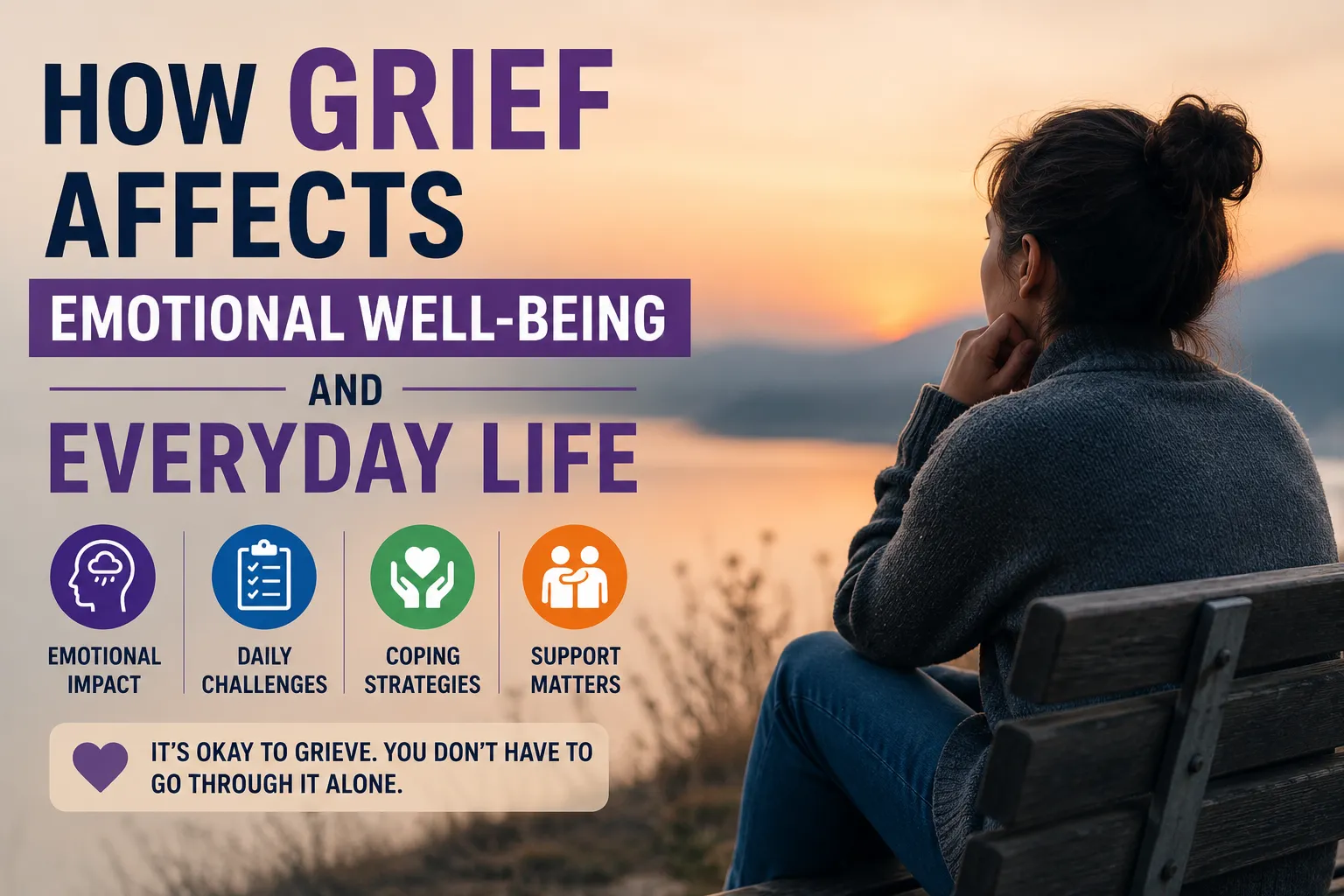

How Grief Affects Emotional Well-Being and Everyday Life
Grief is a natural response to losing someone, something or a way of life that matters deeply. It is often associated with the death of a loved one, but people can also experience grief after the end of a relationship, loss of employment, serious illness, major life changes or the loss of a familiar sense of security.
Although grief is universal, it does not follow a single pattern. Some people experience intense sadness, while others may feel anger, confusion, numbness or even relief. Emotions can change from one day to the next, making grief difficult to predict.
Understanding how grief affects emotional well-being and everyday life can make the experience less confusing and help people recognize when additional support may be useful. Grief is also one aspect of the broader emotional health picture explored in The Complete Guide to Emotional Well-Being.
What Is Grief?
Grief is the emotional, psychological and sometimes physical response to loss.
It can affect many areas of life at the same time, including:
-
Mood
-
Sleep
-
Appetite
-
Concentration
-
Energy
-
Relationships
-
Work or school
-
Social activities
-
Physical well-being
-
Sense of identity
Grief is not simply sadness. A grieving person may experience several emotions simultaneously or move between emotions unexpectedly.
Someone may feel deeply sad in the morning, distracted during the afternoon and relatively calm in the evening. A memory, song, photograph or familiar place can then bring a sudden wave of emotion.
These fluctuations are common parts of the grieving experience.
How Grief Changes Emotional Well-Being
Loss can temporarily change how people understand themselves and the world around them.
A person may experience:
Sadness
Sadness is one of the most recognizable responses to loss. It can range from a quiet sense of emptiness to overwhelming emotional pain.
Anger
People may feel angry about what happened, toward other people, themselves or circumstances they cannot control.
Guilt
Some people repeatedly think about what they could have done differently.
Thoughts such as “I should have called” or “I could have done more” can become particularly painful after a loss.
Anxiety
A major loss can make the future feel uncertain. People may worry about what comes next, particularly when the loss changes their financial situation, family structure, health or daily responsibilities.
Numbness
Not everyone immediately experiences strong emotions. Some people initially feel emotionally numb or disconnected from what has happened.
This can be a temporary response to overwhelming circumstances.
Loneliness
Grief can create a powerful sense of absence, particularly when the person who died or left was part of everyday routines.
Even when surrounded by other people, someone may feel profoundly alone.
This aspect of grief can overlap with the emotional effects discussed in How Loneliness and Social Connection Affect Mental Wellbeing.
How Grief Can Affect Concentration
One of the less obvious effects of grief is difficulty concentrating.
A grieving person may find it harder to:
-
Read for long periods
-
Follow conversations
-
Remember appointments
-
Make decisions
-
Complete complicated tasks
-
Stay focused at work
-
Organize household responsibilities
This can happen because emotional distress consumes mental attention.
Someone may spend considerable time thinking about the loss, replaying memories or trying to understand what happened.
As a result, ordinary tasks can require more effort than usual.
Why Decision-Making Can Feel Difficult
Grief can make even simple decisions feel exhausting.
Choosing what to eat, responding to messages or deciding what needs to be done first may suddenly feel overwhelming.
When possible, reducing unnecessary decisions can help.
Creating simple routines, preparing meals in advance or writing down important tasks can provide structure during periods when mental energy is limited.
Sleep Can Change During Grief
Grief can significantly disrupt normal sleep patterns.
Some people struggle to fall asleep because their thoughts become particularly active at night.
Others may sleep much more than usual because they feel emotionally or physically exhausted.
Sleep disruption can then make other aspects of grief more difficult.
Poor sleep can contribute to:
-
Irritability
-
Fatigue
-
Difficulty concentrating
-
Low motivation
-
Emotional sensitivity
Maintaining a reasonably consistent sleep schedule can provide some stability, even when sleep itself remains difficult.
Appetite and Eating Habits May Change
Grief can affect appetite in different ways.
Some people lose interest in food, while others eat more frequently for comfort.
A grieving person may also stop paying attention to regular meals because everyday routines have become difficult to maintain.
During intense periods of grief, basic nourishment can become especially important.
Simple meals, regular hydration and support from family or friends can make it easier to maintain basic physical needs.
Grief Can Affect Physical Health
Emotional distress does not exist separately from the body.
Grief can be accompanied by physical experiences such as:
-
Fatigue
-
Muscle tension
-
Headaches
-
Changes in appetite
-
Sleep disruption
-
Restlessness
-
A heavy or tight feeling in the chest
-
General aches
These experiences can be unsettling, particularly when someone is not expecting grief to affect the body.
Persistent or severe physical symptoms should not automatically be attributed to grief. New or concerning symptoms may require evaluation by a healthcare professional.
Everyday Routines Can Feel Different
One of the most challenging aspects of grief is that ordinary life continues.
Bills still need to be paid.
Meals still need to be prepared.
Children may still need care.
Work responsibilities remain.
Appointments continue.
Yet internally, a person’s world may feel completely different.
This contrast can make everyday responsibilities feel unusually demanding.
Why Familiar Routines Can Help
Maintaining basic routines can provide a sense of stability during uncertainty.
Simple activities such as:
-
Getting up at a regular time
-
Eating regular meals
-
Taking a short walk
-
Going to work when possible
-
Keeping up with basic household tasks
-
Staying connected with trusted people
can create predictable points in the day.
Routines do not eliminate grief. They provide structure while someone learns to live with a changed reality.
Building practical routines can also be part of developing healthy coping skills for difficult emotional periods.
Grief Can Change Relationships
People respond to grief differently, and those differences can sometimes create misunderstandings.
One person may want to talk about the loss frequently.
Another may prefer privacy.
Someone may want company while another person needs time alone.
Family members can therefore experience the same loss in very different ways.
Why Communication Matters
Explaining what you need can make relationships easier to navigate.
A grieving person might say:
“I don’t need advice right now. I just need someone to listen.”
Or:
“I would like some company, but I don’t feel like talking about what happened.”
Clear communication can help friends and relatives provide support without making assumptions.
The ability to communicate needs and respect different emotional responses is also an important part of healthy relationships.
Grief Can Affect Work and Productivity
Returning to work does not necessarily mean that grief has ended.
A person may physically return to their workplace while still experiencing significant emotional distress.
Concentration may be reduced, motivation may fluctuate and ordinary tasks may take longer.
Depending on the circumstances, temporary flexibility can help.
This might involve:
-
Adjusting workloads
-
Taking breaks
-
Working flexible hours
-
Using available leave
-
Asking for practical assistance
-
Temporarily reducing nonessential responsibilities
People should not assume that everyone will be ready to resume normal productivity on the same timetable.
Grief Is Not a Straight Line
One of the most common misunderstandings about grief is the idea that it follows a predictable sequence.
In reality, emotions often fluctuate.
A person might feel better for several days and then experience intense sadness after encountering a reminder of the person or situation they lost.
This does not necessarily mean they have “gone backward.”
Grief can involve periods of adjustment followed by unexpected emotional reactions.
Triggers Can Bring Emotions Back
A trigger can be almost anything associated with the loss.
Examples include:
-
A birthday
-
A holiday
-
A familiar song
-
A photograph
-
A smell
-
A favorite restaurant
-
A particular location
-
An anniversary
-
A personal belonging
These reminders can produce strong emotions even months or years later.
Experiencing emotion after a reminder does not mean that someone has failed to move forward.
Grief and Identity
Major losses can change how people see themselves.
A person who loses a spouse may suddenly have to adjust to life without being part of a partnership.
Someone who loses a job may struggle with a changed sense of purpose or professional identity.
A parent whose child leaves home may experience a different kind of transition.
These experiences can create questions such as:
-
Who am I now?
-
What does my future look like?
-
What should I do differently?
-
What gives my life meaning now?
Part of adapting to grief can involve gradually developing a new sense of identity around a changed set of circumstances.
Major changes such as these can also be understood within the broader emotional effects described in How Major Life Transitions Affect Mental Wellbeing.
Children and Teenagers Experience Grief Differently
Children may not express grief in the same way adults do.
They may:
-
Ask repeated questions
-
Become unusually quiet
-
Have difficulty sleeping
-
Become irritable
-
Return temporarily to earlier behaviors
-
Struggle at school
-
Play normally and then suddenly become upset
Young people may move quickly between grief and ordinary activities.
Playing or laughing does not necessarily mean a child has stopped grieving.
Adults can help by providing honest, age-appropriate information, maintaining routines and creating opportunities for children to ask questions.
Different Cultures Approach Grief Differently
There is no single universal way to mourn.
Families and cultures have different traditions surrounding:
-
Funerals
-
Memorials
-
Religious practices
-
Community gatherings
-
Clothing
-
Food
-
Expressions of emotion
-
Remembrance
These practices can provide structure and a sense of connection.
Respecting cultural and personal differences is important because one person’s way of grieving may look very different from another’s.
What Does Healthy Grieving Look Like?
There is no single emotional pattern that qualifies as “healthy” grief.
Generally, adaptation involves gradually finding ways to live with the reality of the loss while continuing to engage with everyday life.
Over time, a person may begin to:
-
Experience periods of calm
-
Reconnect with other people
-
Return to activities
-
Develop new routines
-
Think about the future
-
Experience positive emotions alongside sadness
-
Remember the loss without being overwhelmed every time
This does not mean forgetting the person or situation that was lost.
It means the loss becomes integrated into a person’s life rather than completely controlling it.
Why Positive Emotions Do Not Mean Someone Has Stopped Caring
A grieving person may feel guilty about laughing, enjoying a meal or having a good day.
But positive emotions can coexist with grief.
Someone can miss a loved one deeply while also enjoying time with friends.
They can feel sadness and gratitude.
They can remember pain and still experience moments of happiness.
Emotional recovery is not a betrayal of the person or life that was lost.
When Grief May Require Additional Support
Grief can be extremely difficult, but some experiences may signal a need for professional support.
Consider seeking help when emotional distress:
-
Remains overwhelming
-
Makes basic daily functioning extremely difficult
-
Causes persistent isolation
-
Seriously disrupts sleep or eating
-
Makes work or school impossible to manage
-
Produces intense hopelessness
-
Leads to persistent feelings of worthlessness
-
Causes severe or prolonged anxiety
-
Creates thoughts of self-harm or suicide
A healthcare professional or mental-health specialist can help determine what type of support may be appropriate.
Seeking help does not mean someone is grieving incorrectly. It means they do not have to manage overwhelming distress alone.
How Friends and Family Can Support Someone Who Is Grieving
People often want to help but are unsure what to say.
Practical support can sometimes be more useful than trying to find the perfect words.
Helpful actions may include:
-
Listening without immediately offering solutions
-
Preparing meals
-
Helping with household tasks
-
Offering transportation
-
Checking in regularly
-
Respecting the person’s need for space
-
Remembering important dates
-
Being patient with changing emotions
Instead of saying, “Let me know if you need anything,” it can be more useful to make a specific offer.
For example:
“I can bring dinner on Thursday.”
Specific offers reduce the burden on a grieving person to identify and request help.
What Not to Say to Someone Who Is Grieving
Even well-intentioned comments can sometimes feel dismissive.
Avoid statements such as:
-
“Everything happens for a reason.”
-
“You need to move on.”
-
“At least they lived a long life.”
-
“I know exactly how you feel.”
-
“You should be over this by now.”
Everyone experiences loss differently.
A better approach is often to acknowledge the person’s experience without trying to explain it away.
Simple statements such as “I’m sorry you’re going through this” or “I’m here to listen” can be more supportive.
Can Grief Affect Mental Wellness for a Long Time?
Yes.
Grief does not necessarily disappear after a particular number of weeks or months.
For some people, adjustment happens relatively quickly. For others, the process takes considerably longer.
The relationship with the person or thing that was lost, the circumstances of the loss, previous experiences, social support and many other factors can influence the grieving process.
The passage of time can change grief, but time alone does not guarantee that every person will recover in the same way.
The Difference Between Grief and Depression
Grief and depression can sometimes look similar, but they are not identical experiences.
Grief often involves waves of emotion connected to the loss. A person may still experience moments of pleasure or connection.
Depression can involve a more persistent loss of interest or pleasure across many areas of life, along with other symptoms.
Because the two can overlap, anyone experiencing persistent or severe emotional distress should consider speaking with a qualified healthcare professional rather than trying to diagnose themselves.
Taking Care of Yourself During Grief
Self-care during grief does not have to involve complicated wellness routines.
Basic needs matter.
Try to:
Maintain Regular Meals
Even small, simple meals can help maintain energy.
Get Some Movement
A short walk or gentle physical activity can provide structure and a change of environment.
Stay Connected
Spending time with trusted people can reduce isolation.
Allow Yourself to Feel
There is no requirement to appear strong every day.
Rest When Possible
Grief can be exhausting, so rest is important.
Avoid Major Decisions When Possible
If circumstances allow, give yourself time before making major life changes while emotions are particularly intense.
Accept Practical Help
Allowing someone to prepare food, handle errands or provide company is not a sign of weakness.
These small acts of care can form part of a broader approach to evidence-based self-care during emotionally demanding periods.
Finding Ways to Remember
For many people, maintaining a connection to what was lost becomes an important part of adjustment.
This might involve:
-
Creating a photo album
-
Writing memories down
-
Visiting a meaningful place
-
Maintaining a tradition
-
Planting a tree
-
Supporting a cause connected to the person
-
Talking about memories with family members
Remembrance can provide a way to acknowledge the importance of the relationship while continuing to build a life in the present.
Learning to Live With Loss
Grief changes people because loss changes circumstances, relationships and expectations about the future. Emotional pain may affect sleep, appetite, concentration, work, relationships and everyday routines, sometimes in ways that are difficult to predict.
There is no universal timetable for feeling better, and experiencing a difficult day after a period of improvement does not necessarily mean that progress has been lost. Gradually rebuilding routines, maintaining supportive relationships and allowing space for changing emotions can help people adapt.
Most importantly, grief does not have to be faced in isolation. When sadness or distress becomes overwhelming or seriously interferes with daily life, professional support can provide another source of guidance. Learning to live with loss is not about forgetting what mattered; it is about finding ways to carry that loss while making room for life to continue.
Continue Reading
Similar Posts

How to Provide Emotional Support to Others
Good emotional support is also about respecting boundaries. People need different kinds of help at different times. Some may want to talk, while others may need practical assistance, quiet companionship, or simply reassurance that someone cares.
Read article
How Stress Affects Concentration and Memory
Understanding the connection between stress, concentration and memory can help explain why the mind sometimes feels less efficient during stressful periods—and why managing stress can be an important part of maintaining overall mental well-being.
Read article
When Should Someone Seek Professional Mental Health Support
Understanding **what mental wellness means** is a useful starting point. Mental wellness involves more than simply being happy or avoiding mental illness. It includes the ability to manage emotions, handle challenges, maintain relationships, make decisions, and function in everyday life.
Read article

Join 10,000+ Readers Building Healthier Habits
Get actionable wellness tips every week plus our newest articles delivered straight to your inbox.