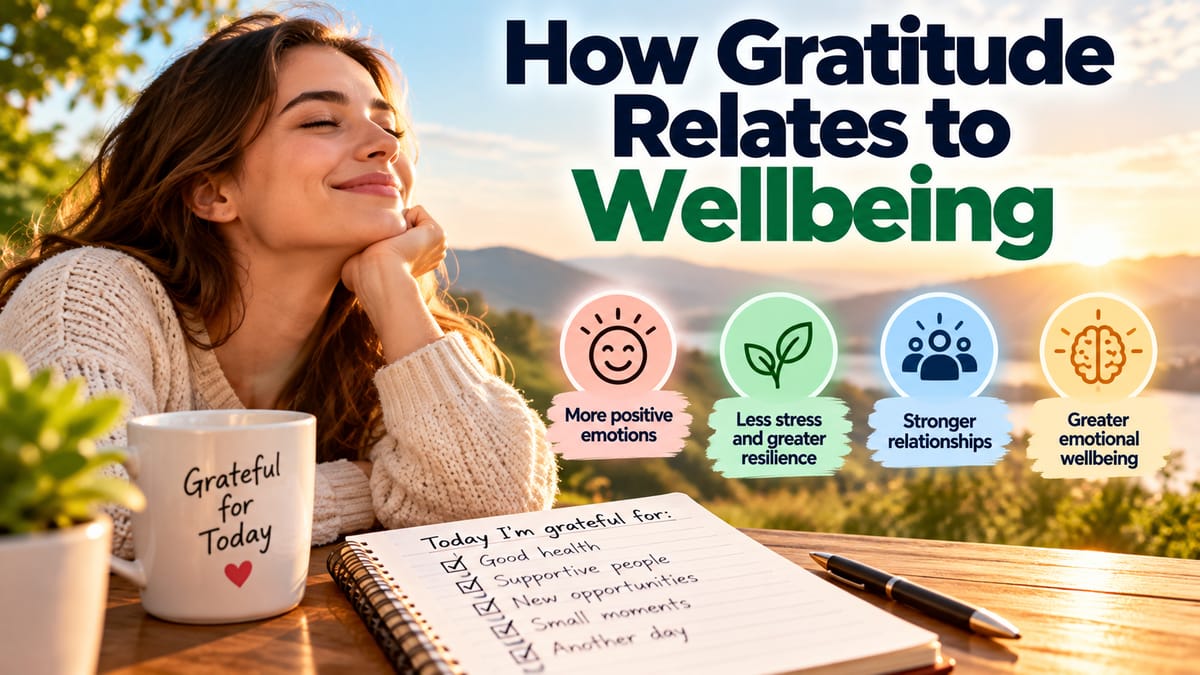

How Gratitude Relates to Wellbeing
Gratitude is often described as the practice of noticing and appreciating things that are meaningful, helpful, or positive. It can involve something as simple as appreciating a supportive friend, enjoying a peaceful morning, recognizing an accomplishment, or being thankful for an everyday convenience that might otherwise go unnoticed.
While gratitude cannot eliminate stress, sadness, uncertainty, or difficult life circumstances, it can influence how people pay attention to their experiences and interpret parts of their lives.
Research into gratitude and wellbeing has explored possible relationships between grateful attitudes, positive emotions, social connection, resilience, and psychological health. Gratitude is not a replacement for professional mental health support, but it can be incorporated into broader habits that support wellbeing.
What Is Gratitude?
Gratitude involves recognizing and appreciating something perceived as beneficial or valuable.
It can be directed toward:
- Another person’s support
- A positive experience
- An opportunity
- A personal accomplishment
- Nature
- Meaningful relationships
- Everyday comforts
- Personal strengths
- Acts of kindness
- Circumstances that contribute to quality of life
Gratitude does not require pretending that everything is good.
A person can experience disappointment, grief, frustration, or stress while also recognizing something they appreciate. This distinction is important because healthy gratitude is not necessarily about suppressing difficult emotions.
What Is Wellbeing?
Wellbeing is broader than simply being happy.
It can include emotional, psychological, social, physical, and other aspects of a person’s quality of life.
The Complete Guide to Emotional Well-Being provides a broader look at the factors that contribute to emotional wellbeing and healthy emotional functioning.
Wellbeing can involve:
- Experiencing meaningful relationships
- Managing everyday stress
- Having a sense of purpose
- Experiencing positive emotions
- Recovering from difficult experiences
- Maintaining healthy routines
- Feeling connected to other people
- Participating in enjoyable activities
- Developing useful coping strategies
Gratitude can potentially contribute to some of these areas, particularly by encouraging people to notice positive experiences and relationships.
How Gratitude May Influence Attention
People cannot consciously focus on every aspect of their lives at the same time.
Attention is selective. When someone is overwhelmed by problems, it can become easy to concentrate almost entirely on what is going wrong.
A gratitude practice can encourage a person to deliberately notice something positive or meaningful.
For example, after a difficult day, someone might recognize:
- A helpful conversation
- A task they successfully completed
- A comfortable place to rest
- A meal they enjoyed
- A moment of laughter
- Someone who offered support
This does not erase the difficult parts of the day. It simply adds another perspective to the overall experience.
Gratitude and Positive Emotions
Gratitude is closely associated with positive emotions such as appreciation, contentment, warmth, and joy.
When people deliberately recognize things they value, they may spend more attention on experiences that produce these emotions.
Positive emotions can be relatively brief, but repeated opportunities to experience them may contribute to broader patterns of wellbeing.
This is one reason gratitude is often included among positive psychological practices.
Gratitude Does Not Mean Ignoring Problems
One common misunderstanding is that gratitude requires people to focus exclusively on positive things.
That approach can become unhelpful if it discourages people from acknowledging genuine problems.
Someone experiencing financial difficulties, relationship conflict, grief, burnout, or another serious challenge does not need to pretend that everything is fine.
A healthier approach is to allow multiple realities to exist at the same time.
For example:
“This situation is difficult, and I am also grateful that I have someone I can talk to.”
Both statements can be true.
Gratitude and Emotional Awareness
Practicing gratitude can encourage people to pause and identify what they are actually experiencing.
Rather than moving automatically from one task to another, a person might take a moment to recognize an experience that mattered to them.
This can promote greater awareness of:
- What brings satisfaction
- Which relationships matter
- Which experiences create meaning
- What support is available
- Which aspects of daily life are appreciated
This kind of reflection can complement broader approaches to emotional wellbeing.
Gratitude and Social Relationships
Gratitude can also have a social dimension.
Expressing appreciation to another person communicates that their actions or presence are valued.
Simple statements such as “thank you,” “I appreciate your help,” or “I’m glad you were there” can strengthen positive interactions.
Gratitude can be directed toward:
- Family members
- Friends
- Colleagues
- Teachers
- Mentors
- Neighbors
- Caregivers
- Community members
Expressing appreciation does not guarantee that a relationship will become stronger, but genuine acknowledgment can contribute to positive social interactions.
Gratitude and a Sense of Connection
People often depend on others in ways that are easy to overlook.
A friend may provide emotional support. A colleague may offer assistance. A family member may help with everyday responsibilities.
Recognizing these contributions can reinforce a sense of connection.
This matters because social relationships are an important part of overall wellbeing.
Gratitude can therefore function not only as an individual reflection but also as a way of acknowledging the relationships that contribute to a person’s life.
Gratitude and Mental Wellness
Mental wellness involves more than the absence of mental illness.
It includes the ability to navigate everyday experiences, manage emotions, maintain relationships, adapt to challenges, and participate meaningfully in life.
The What Is Mental Wellness? guide provides a broader explanation of mental wellness and the factors that can support it.
Gratitude can be one small practice within this larger picture.
It should not be viewed as a universal solution or as something that must be practiced perfectly. Its potential value comes from how it can complement other healthy behaviors and sources of support.
Gratitude Can Shift the Way People Interpret Ordinary Experiences
Many positive experiences are ordinary enough to become easy to overlook.
A quiet cup of tea, a conversation with a friend, a comfortable home, a walk outside, or completing an important task may not seem remarkable.
Regular gratitude can encourage people to pause and recognize these experiences rather than automatically moving past them.
This can make everyday positive experiences more noticeable.
The experience itself may not change, but the amount of attention given to it can.
Gratitude and Stress
Stress can narrow attention toward immediate problems.
When people are under pressure, their thoughts may become dominated by deadlines, uncertainty, conflict, responsibilities, or perceived threats.
A brief gratitude exercise can introduce a different focus.
For example, someone might pause during a stressful day and identify three things that are currently going well or three people who provide support.
This does not solve the source of the stress, but it can create a short mental break from an exclusively problem-focused perspective.
Gratitude should therefore be considered a complementary practice rather than a substitute for addressing the cause of ongoing stress.
Gratitude and Resilience
Resilience refers broadly to the ability to adapt to challenges and recover from difficult experiences.
Gratitude may contribute to resilience by helping people recognize resources that remain available during challenging periods.
These resources can include:
- Supportive relationships
- Personal strengths
- Previous accomplishments
- Practical resources
- Meaningful experiences
- Community connections
- Opportunities for recovery
Recognizing these resources does not make a difficult situation disappear. It can, however, help broaden the picture of what a person has available to them.
Gratitude and Positive Habits
Gratitude tends to work best when it becomes part of a broader approach to healthy living rather than an isolated exercise.
Other positive habits may include:
- Regular physical activity
- Adequate sleep
- Meaningful social interaction
- Time outdoors
- Healthy eating
- Relaxation
- Self-reflection
- Setting reasonable boundaries
- Making time for enjoyable activities
The How Positive Habits Support Mental Wellness guide explores how repeated healthy behaviors can contribute to mental wellbeing.
A gratitude practice can fit naturally alongside these habits.
Different Ways to Practice Gratitude
There is no single correct way to practice gratitude.
Some people prefer writing, while others find that speaking or thinking about appreciation works better.
Possible approaches include:
Keep a Gratitude Journal
Write down a few things you appreciate at the end of the day.
These do not need to be major events. Small experiences can be meaningful.
Send a Thank-You Message
Send a genuine message to someone whose support or kindness you appreciate.
Practice Gratitude During Meals
Take a moment before eating to recognize the food, people, effort, or circumstances that made the meal possible.
Notice One Positive Moment
At the end of each day, identify one experience that brought enjoyment, comfort, or meaning.
Express Appreciation Directly
Tell someone specifically what you appreciate about their actions.
Use Gratitude During a Walk
While walking, deliberately notice things you value about your surroundings.
The best approach is the one that feels natural enough to repeat.
Gratitude Does Not Need to Be Complicated
A gratitude practice does not require a special journal, lengthy meditation session, or complicated routine.
It can take less than a minute.
For example:
Pause → Notice → Appreciate.
Pause for a moment.
Notice something meaningful or positive.
Allow yourself to appreciate it.
The simplicity of this process can make gratitude easier to incorporate into ordinary life.
Gratitude and Mindfulness
Gratitude and mindfulness are related but distinct practices.
Mindfulness involves paying attention to present-moment experiences with greater awareness and without automatically judging them.
Gratitude involves recognizing and appreciating something perceived as valuable.
They can work together.
During a mindful walk, for example, someone might notice the weather, sounds, surroundings, and sensations of movement. They might then recognize that they appreciate having the opportunity to spend time outside.
The Complete Guide to Mindfulness and Present-Moment Awareness explores mindfulness in greater detail.
Gratitude Can Be Practiced Without Comparing Yourself to Others
Gratitude sometimes becomes associated with comparisons such as “I should be thankful because other people have less.”
This approach can be problematic because it may encourage guilt rather than genuine appreciation.
A person does not need to compare their circumstances with someone else’s suffering to recognize something valuable in their own life.
Gratitude can simply focus on personal appreciation.
For example:
“I am grateful for the support my friend gave me this week.”
There is no need to add a comparison to someone else’s situation.
Gratitude and Difficult Emotions Can Coexist
People can experience gratitude while also feeling:
- Sad
- Angry
- Worried
- Disappointed
- Lonely
- Frustrated
- Grieving
Emotional experiences are not always mutually exclusive.
Someone grieving a loss might be deeply sad while also appreciating memories of the person they lost. Someone facing a difficult work situation might feel frustrated while appreciating supportive colleagues.
Recognizing gratitude does not invalidate another emotion.
Avoid Turning Gratitude Into a Requirement
A gratitude practice can become counterproductive if it feels like another obligation.
There is no requirement to identify a fixed number of positive things every day.
Some days may naturally contain more opportunities for appreciation than others.
A flexible approach may be more sustainable:
- Write when you feel like reflecting
- Express appreciation when someone helps you
- Notice positive moments during ordinary activities
- Return to the practice when it feels useful
The objective is meaningful awareness rather than perfect consistency.
Gratitude and Self-Appreciation
Gratitude does not always have to focus on other people or external circumstances.
People can also recognize their own efforts.
Examples include appreciating:
- Completing a difficult task
- Setting an important boundary
- Asking for help
- Maintaining a healthy habit
- Recovering after a setback
- Showing patience
- Learning something new
Self-appreciation should not require ignoring mistakes. It can simply acknowledge effort and progress.
Gratitude in Everyday Life
The most sustainable gratitude practices are often connected to activities that already happen.
For example:
Morning: identify one thing you are looking forward to.
During work: acknowledge someone’s useful contribution.
During a meal: appreciate the food and the effort involved in preparing it.
During an evening routine: remember one positive moment from the day.
These small practices can make gratitude feel less like a separate task.
What Gratitude Cannot Do
Gratitude has limits.
It cannot guarantee happiness, eliminate stress, resolve relationship problems, cure mental health conditions, or prevent difficult events.
Someone experiencing persistent sadness, severe anxiety, trauma-related symptoms, thoughts of self-harm, or significant difficulty functioning may need professional support rather than relying solely on self-help practices.
Gratitude can be part of a healthy lifestyle, but it should not be used to dismiss serious concerns.
When Gratitude Feels Difficult
There may be periods when finding something to appreciate feels nearly impossible.
During grief, exhaustion, major life changes, or severe stress, forcing positive thinking can feel unrealistic.
In these situations, gratitude can be made extremely simple.
Instead of searching for something extraordinary, notice something neutral or comforting:
- A quiet moment
- A comfortable chair
- A warm shower
- A supportive message
- A favorite song
- A safe place to rest
- A small task completed
Even then, there is no requirement to force gratitude.
Sometimes simply acknowledging that a day is difficult is more appropriate than trying to make it sound positive.
Building a Sustainable Gratitude Practice
A sustainable practice should fit naturally into everyday life.
Start with something small.
For example:
- Choose one regular time of day.
- Spend one or two minutes reflecting.
- Identify one thing you genuinely appreciate.
- Be specific about why it matters.
- Avoid comparing your situation with others.
- Do not force positivity when difficult emotions need attention.
- Adjust the practice if it starts to feel burdensome.
Over time, gratitude can become a familiar form of reflection rather than another task on a checklist.
Why Small Moments of Appreciation Can Matter
Wellbeing is influenced by many factors, and no single habit determines how someone feels.
Gratitude can nevertheless provide a simple way to notice positive experiences, recognize supportive relationships, and bring greater attention to aspects of life that might otherwise pass unnoticed.
Its value is often found in small moments rather than dramatic transformations.
A person may appreciate a conversation, recognize their own effort, notice something beautiful outdoors, or acknowledge a source of support. These moments do not remove life’s difficulties, but they can become part of a broader pattern of emotional awareness and healthy living.
Gratitude is therefore best understood as one modest practice within a much larger approach to wellbeing—one that can coexist with difficult emotions, meaningful relationships, healthy habits, mindfulness, and appropriate support when life becomes challenging.
Continue Reading
Similar Posts

How to Recognize Common Burnout Patterns
Understanding common burnout patterns can help people notice changes in their wellbeing and consider what needs to change before exhaustion becomes deeply established.
Read article
How People Recover From Difficult Experiences
Understanding how recovery works can make it easier to recognize healthy progress and identify when additional support may be useful.
Read article
How Belonging Supports Mental Wellness
Understanding the relationship between belonging and mental wellness can help explain why healthy social connections are an important part of a balanced life.
Read article

Join 10,000+ Readers Building Healthier Habits
Get actionable wellness tips every week plus our newest articles delivered straight to your inbox.