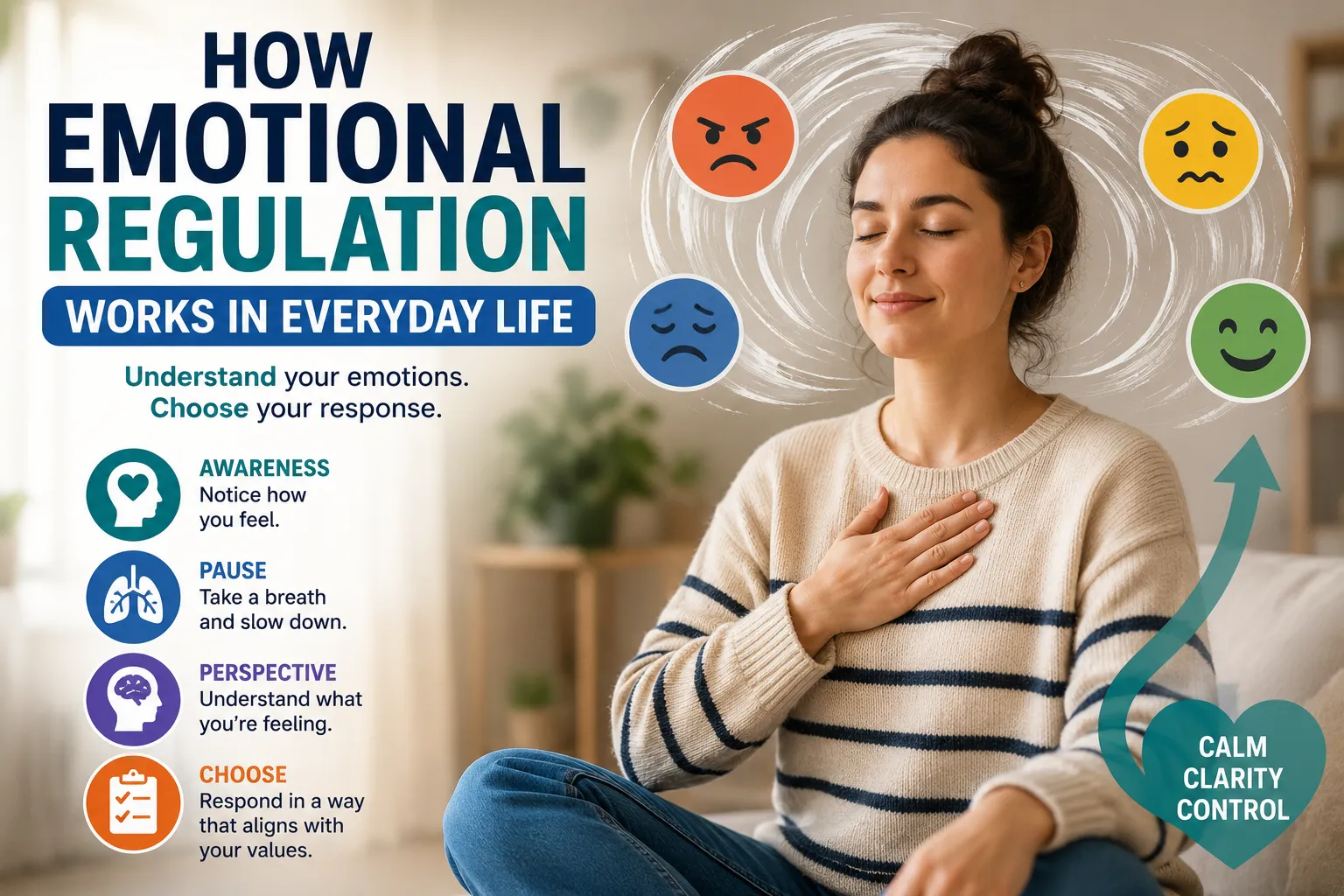

How Emotional Regulation Works in Everyday Life
Emotions are a normal part of being human. Joy, frustration, anxiety, disappointment, excitement and anger can all provide useful information about what is happening around us.
But emotions do not always arrive at convenient moments.
A difficult conversation can trigger anger just before an important meeting. A disappointing message can make it difficult to concentrate. Stress from work can follow someone home and affect how they interact with family.
The ability to respond to these experiences without being completely overwhelmed is known as emotional regulation.
Emotional regulation does not mean suppressing feelings or trying to remain positive all the time. Instead, it involves recognizing emotions, understanding what may be driving them and choosing how to respond in a way that fits the situation.
What Is Emotional Regulation?**
Emotional regulation is the process of managing emotional responses so they remain workable and appropriate to a situation.
People regulate emotions in many different ways, often without consciously thinking about it.
Someone who feels angry might pause before responding to a message. A person who feels nervous before a presentation might take several slow breaths. Someone dealing with disappointment might talk to a friend, go for a walk or give themselves time to process what happened.
These are all examples of regulating an emotional response.
Importantly, regulation is not the same as eliminating an emotion.
Feeling angry does not necessarily mean the goal should be to stop feeling angry. The goal may instead be to prevent the anger from leading to an impulsive decision or hurtful reaction.
Emotional regulation is one part of broader emotional wellbeing, which is explored in The Complete Guide to Emotional Well-Being.
Why Emotions Exist**
Emotions serve important functions.
Fear can draw attention to potential danger. Anger can signal that someone feels threatened, treated unfairly or frustrated. Sadness can indicate loss or disappointment. Happiness can reinforce experiences that people find rewarding.
Emotions can therefore influence attention, memory, decision-making and behavior.
The challenge is that emotional reactions can sometimes be stronger, longer-lasting or less appropriate to the circumstances than necessary.
Emotional regulation provides a way to respond to those reactions without automatically acting on them.
The Difference Between Feeling and Reacting**
One of the most useful ways to understand emotional regulation is to distinguish between an emotional experience and a behavioral response.
A person may feel angry without shouting.
Someone may feel anxious without immediately avoiding a situation.
A person may feel disappointed without giving up on a goal.
The feeling itself can arise automatically. What happens afterward can involve more choice.
That small distinction creates an opportunity to pause and decide what to do next.
For people dealing with strong emotional reactions, developing healthy coping skills can provide additional ways to respond to difficult experiences.
Emotional Regulation Begins With Awareness**
It is difficult to regulate an emotion that has not been recognized.
Emotional awareness involves noticing what is happening internally.
Instead of simply thinking, “I feel bad,” a person might identify a more specific experience:
-
“I’m frustrated.”
-
“I’m worried about what will happen.”
-
“I’m embarrassed.”
-
“I’m disappointed.”
-
“I’m overwhelmed.”
-
“I’m irritated because I feel ignored.”
Putting an accurate name to an emotion can make the experience easier to understand.
It can also help separate the emotion from the story surrounding it.
This kind of present-moment awareness is closely related to mindfulness and present-moment awareness, which emphasizes noticing thoughts, feelings and sensations without automatically reacting to them.
Physical Signals Can Reveal Emotional Changes**
Emotions are not only psychological experiences. They can also produce physical changes.
Depending on the emotion, someone might notice:
-
Faster breathing
-
Increased heart rate
-
Muscle tension
-
Sweating
-
Restlessness
-
A tight feeling in the chest or stomach
-
Fatigue
-
Changes in appetite
-
Difficulty concentrating
Learning to recognize these signals can help people notice emotional escalation earlier.
For example, someone who recognizes that their shoulders are tense and their breathing has become rapid may realize they are becoming increasingly stressed before that stress affects their behavior.
The Brain Helps Regulate Emotional Responses**
Emotional regulation involves several interacting brain systems rather than a single “emotion center.”
Brain regions involved in detecting threats, generating emotional responses, processing memories and making decisions communicate with one another.
The amygdala is often discussed in relation to emotional processing, particularly responses to potential threats. Areas of the prefrontal cortex are involved in planning, decision-making and regulating responses.
This interaction helps explain why strong emotions can sometimes make careful thinking more difficult.
When someone is highly stressed or emotionally activated, concentrating on long-term consequences can become harder.
Stress Can Make Regulation More Difficult**
Everyday stress can reduce a person’s capacity to manage emotional reactions.
Poor sleep, excessive workload, financial worries, relationship conflict and constant demands can all contribute to emotional strain.
When stress accumulates, relatively small problems can sometimes produce disproportionately strong reactions.
This does not necessarily mean the immediate event is the entire problem.
Someone who becomes unusually irritated after a minor inconvenience may actually be responding to several days of accumulated stress.
Recognizing that connection can help explain why emotional reactions vary from one day to another.
Learning how to reduce and manage these pressures is an important part of The Complete Guide to Stress Management.
Sleep Plays an Important Role**
Sleep affects attention, mood and the ability to respond effectively to stressful situations.
When people are consistently sleep-deprived, they may find it more difficult to concentrate, think through problems and maintain patience.
A good night’s sleep cannot solve every emotional difficulty, but maintaining regular sleep habits can support the mental processes involved in emotional regulation.
This is one reason basic routines can matter when dealing with everyday stress.
Breathing Can Help Create a Pause**
When people become emotionally activated, their breathing may become faster or shallower.
Deliberately slowing the breath can provide a simple opportunity to pause.
Rather than immediately responding to an upsetting situation, a person can take several slower breaths and allow some time for the initial reaction to settle.
The goal is not to force an emotion to disappear.
It is to create enough space between the emotional trigger and the response to make a more deliberate choice.
Reframing Can Change How a Situation Is Experienced**
Another important regulation strategy is cognitive reappraisal, which involves reconsidering how a situation is interpreted.
Imagine sending an important message and receiving no response.
One interpretation might be:
“They are deliberately ignoring me.”
Another might be:
“I don’t know why they haven’t responded yet.”
The second interpretation does not guarantee a better outcome, but it avoids treating an assumption as established fact.
Reframing can reduce unnecessary emotional escalation by creating room for alternative explanations.
Thoughts Can Intensify Emotions**
Emotions and thoughts influence one another.
A disappointing event may trigger a thought such as, “Nothing ever works out for me.”
That thought can intensify sadness or frustration, which may then produce more negative thinking.
The cycle can become self-reinforcing.
Recognizing exaggerated or absolute thinking can help interrupt the process.
Instead of “Everything is going wrong,” a person might recognize, “This situation went badly, but not everything is going badly.”
That distinction can make an emotional response more manageable without denying that the original problem is real.
Emotional Regulation Does Not Mean Positive Thinking**
There is a difference between healthy reframing and pretending that negative experiences do not matter.
Someone experiencing grief, disappointment or anger does not necessarily need to replace those emotions with positive thoughts.
Trying to force positivity can sometimes make people feel as though their legitimate emotions are unacceptable.
Healthy emotional regulation allows difficult feelings to exist while preventing those feelings from completely controlling behavior.
The goal is flexibility, not constant happiness.
Taking a Break Can Prevent Escalation**
Sometimes the best response to a strong emotion is temporary distance.
During an argument, for example, continuing the conversation while both people are extremely angry may make the situation worse.
A short break can provide time to calm down and organize thoughts.
The important distinction is between taking a deliberate pause and simply avoiding a problem indefinitely.
A useful break has the purpose of returning to the issue with greater clarity.
Physical Activity Can Influence Mood**
Movement can also be part of emotional regulation.
Walking, stretching, exercising or participating in recreational activities can provide a change of environment and help shift attention away from an immediate source of stress.
Physical activity is not a universal solution for emotional difficulties, but it can be a practical part of a broader routine that supports wellbeing.
Even a short walk can create a useful transition between different parts of the day.
Talking to Other People Can Help**
Humans regulate emotions socially as well as individually.
Talking with a trusted friend, family member, colleague or professional can help someone organize thoughts and put an experience into perspective.
Sometimes people do not need immediate advice.
They may simply need someone to listen.
Social connection can also reduce the sense that a difficult experience has to be handled alone.
Strong social support can be especially valuable when people are working through ongoing emotional difficulties, relationship challenges or stressful periods.
Writing Can Help Organize Emotional Experiences**
Journaling is another method some people use to process emotions.
Writing down what happened, what was felt and what thoughts followed can reveal patterns that are difficult to notice in the moment.
For example, someone might discover that they regularly become anxious before certain types of conversations or that stress increases when they have not taken adequate breaks.
Writing can turn an unclear emotional experience into something that can be examined more deliberately.
Emotional Regulation Takes Practice**
People are not equally skilled at emotional regulation, and the ability can change over time.
Someone may handle stress well in one situation and struggle considerably in another.
The objective is not perfect control.
Instead, emotional regulation can improve through repeated practice:
-
Notice the emotion.
-
Identify what triggered it.
-
Recognize the physical and mental signals.
-
Pause before reacting.
-
Consider possible interpretations.
-
Choose a response that fits the situation.
-
Reflect on what happened afterward.
Over time, this process can become more automatic.
Children Learn Regulation Gradually**
Emotional regulation develops throughout childhood and adolescence.
Young children often have fewer tools for identifying and managing strong emotions. Adults can help by naming feelings, demonstrating calm responses, establishing predictable routines and teaching appropriate ways to express frustration.
As children mature, they gradually develop greater capacity to understand emotional experiences and manage their behavior.
The same basic principle applies to adults: regulation skills can continue developing throughout life.
Technology Can Affect Emotional Regulation**
Modern digital environments can influence emotional states.
Constant notifications, social media feeds, online arguments and exposure to distressing information can keep people mentally engaged even when they are physically resting.
A person who repeatedly checks an upsetting news story or enters online arguments may find it harder to disengage from the emotional experience.
Creating boundaries around notifications, social media and screen use can provide valuable mental space.
The issue is not that technology is inherently harmful. It is that constant stimulation can make it harder to recognize when the mind needs a break.
For a broader look at this issue, see How Digital Habits and Screen Time Affect Mental Wellness.
Food and Daily Routines Can Influence How People Feel**
Everyday routines can affect energy, concentration and mood.
Regular meals, adequate hydration, movement, sleep and periods of rest can support the body’s ability to handle ordinary stress.
These habits should not be treated as cures for serious mental health conditions.
Rather, they are part of the basic foundation that can make everyday emotional challenges easier to manage.
Emotional Suppression Is Different From Regulation**
One of the most important distinctions is between regulating an emotion and suppressing it.
Suppression involves attempting to hide, deny or push away an emotional experience.
Regulation involves acknowledging the emotion while deciding how to respond.
For example, saying “I’m angry, but I’m going to wait until I can discuss this calmly” is regulation.
Saying “I’m not angry at all” while the anger continues building internally is closer to suppression.
Healthy emotional functioning generally involves making room for emotions rather than treating them as unacceptable.
Some Emotions Need to Be Experienced**
Not every uncomfortable feeling needs to be immediately eliminated.
Sadness after a loss, nervousness before an important event and disappointment after a setback can all be normal reactions.
Trying to escape every uncomfortable emotion can sometimes reinforce the idea that those feelings are dangerous or intolerable.
Emotional resilience partly involves learning that difficult emotions can rise, change and eventually subside.
Building this capacity is closely related to The Complete Guide to Building Resilience, which explores how people can develop greater ability to adapt to challenges.
That does not mean ignoring serious problems. It means recognizing that experiencing discomfort is not necessarily evidence that something has gone wrong psychologically.
When Emotional Reactions Become Difficult to Manage**
Everyone loses patience or becomes overwhelmed occasionally.
However, persistent or severe difficulties with emotional regulation can interfere with relationships, work, school or everyday functioning.
Someone who frequently experiences overwhelming emotional reactions, cannot recover from them or feels unable to manage daily responsibilities may benefit from speaking with a qualified mental health professional.
Professional support can help identify underlying issues and develop strategies suited to the individual’s circumstances.
Seeking help is not a sign of failure. It is another way of responding deliberately to a difficult situation.
Emotional Regulation Is About Flexibility**
The healthiest form of emotional regulation is not perfect calm.
Life will continue to produce situations that trigger anger, sadness, fear, excitement and disappointment.
What matters is developing enough flexibility to experience those emotions without automatically allowing them to determine what happens next.
Sometimes the right response is to speak up. Sometimes it is to walk away temporarily. Sometimes it is to ask for help. Sometimes it is simply to allow an emotion to exist without immediately acting on it.
The skill lies in recognizing which response fits the moment.
Building a More Thoughtful Response to Everyday Emotions**
Emotional regulation is something people practice throughout ordinary life, often in moments that seem insignificant.
It happens when someone pauses before sending an angry message, takes a breath before answering a difficult question, challenges an assumption, asks for support or decides to revisit an argument after everyone has calmed down.
These small choices can add up.
The goal is not to become someone who never feels overwhelmed, frustrated or upset. It is to become better at recognizing what is happening internally and creating enough space to respond rather than simply react.
In everyday life, that space between feeling something and deciding what to do about it is where emotional regulation becomes most useful.
Continue Reading
Similar Posts

How to Provide Emotional Support to Others
Good emotional support is also about respecting boundaries. People need different kinds of help at different times. Some may want to talk, while others may need practical assistance, quiet companionship, or simply reassurance that someone cares.
Read article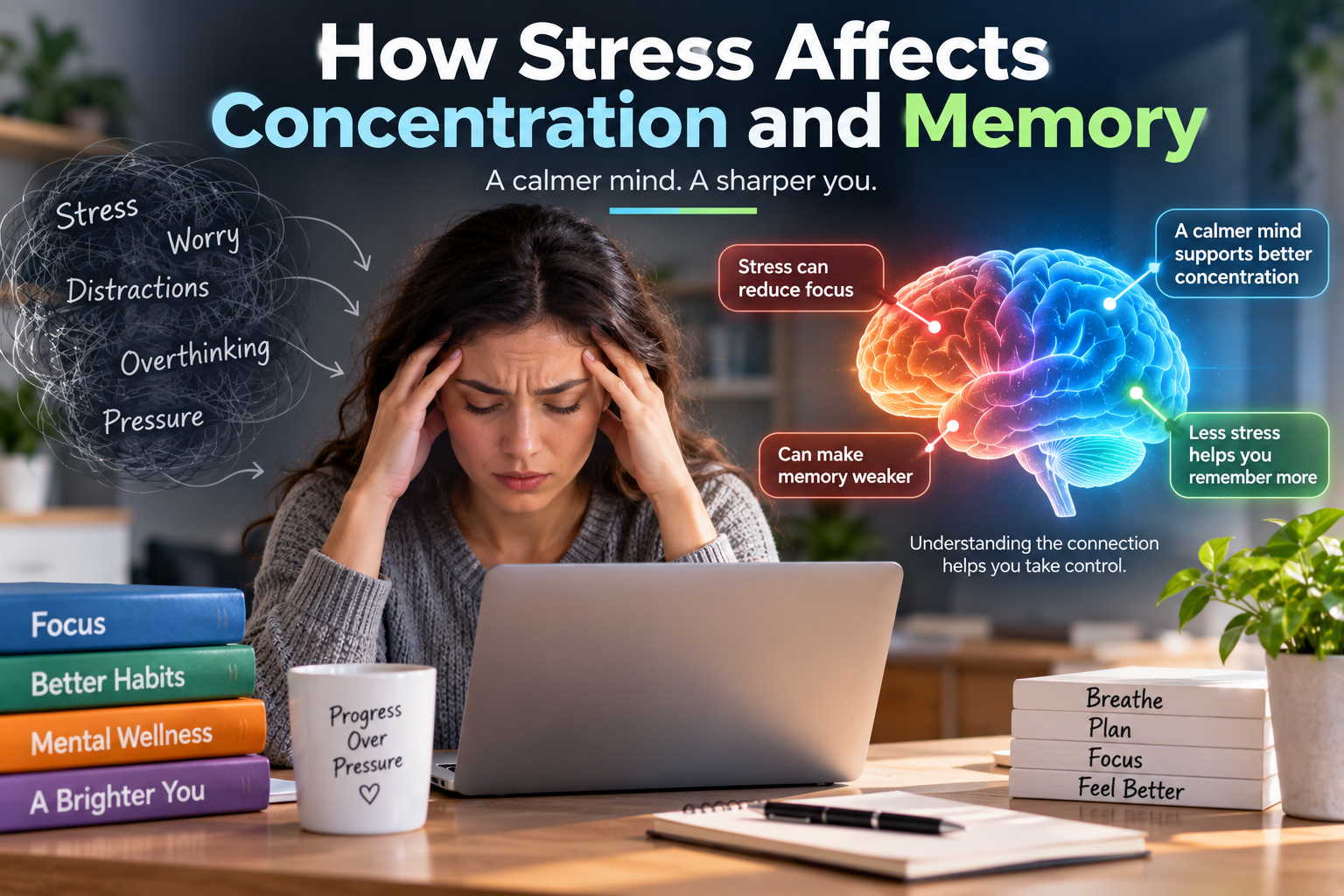
How Stress Affects Concentration and Memory
Understanding the connection between stress, concentration and memory can help explain why the mind sometimes feels less efficient during stressful periods—and why managing stress can be an important part of maintaining overall mental well-being.
Read article
When Should Someone Seek Professional Mental Health Support
Understanding **what mental wellness means** is a useful starting point. Mental wellness involves more than simply being happy or avoiding mental illness. It includes the ability to manage emotions, handle challenges, maintain relationships, make decisions, and function in everyday life.
Read article

Join 10,000+ Readers Building Healthier Habits
Get actionable wellness tips every week plus our newest articles delivered straight to your inbox.