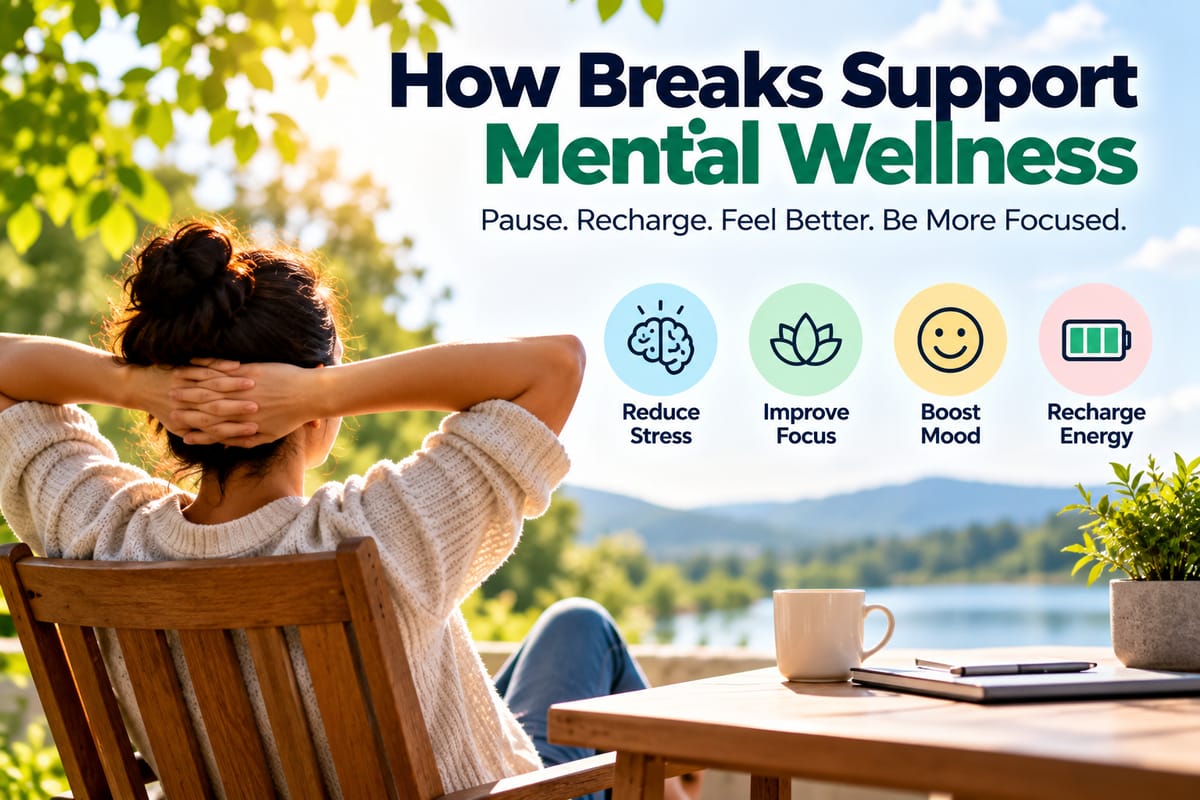

How Breaks Support Mental Wellness
Modern life can make it easy to stay busy from morning until night. Work, school, household responsibilities, social commitments and digital notifications can fill much of the day, leaving little time to pause.
Taking regular breaks can provide an important counterbalance.
A break does not necessarily mean taking an entire day off or going on vacation. It can be a few quiet minutes between tasks, a walk during the workday, time away from a screen or an evening spent without work-related responsibilities.
When used thoughtfully, breaks can give the mind an opportunity to shift attention, recover from sustained demands and return to activities with greater awareness. They can also support healthier routines by creating space for sleep, movement, social connection, reflection and enjoyable activities.
Understanding how breaks fit into mental wellness can help people move away from the idea that constant productivity is always desirable.
What Is a Mental Wellness Break?
A mental wellness break is a period in which a person temporarily steps away from a demanding activity or environment to give their attention and energy a chance to recover.
The length and purpose can vary considerably.
A short break might involve:
- Standing up and stretching
- Taking several slow breaths
- Walking outside
- Drinking water
- Looking away from a screen
- Listening to music
- Talking briefly with a friend
- Sitting quietly
A longer break might involve:
- Taking a lunch period away from work
- Spending an evening without work tasks
- Participating in a hobby
- Taking a day off
- Spending time in nature
- Going on vacation
The important element is not simply stopping work. It is creating meaningful separation from a demanding activity when possible.
Why Constant Activity Can Become Difficult
People have different capacities for sustained attention and stress.
When demands continue without sufficient opportunities for recovery, a person may begin to feel mentally tired, irritable, distracted or overwhelmed.
Continuous activity can also make it difficult to notice basic needs.
Someone focused on completing tasks may forget to:
- Eat regularly
- Drink enough water
- Move around
- Rest their eyes
- Spend time with other people
- Process emotions
- Get enough sleep
Breaks can interrupt this pattern and create opportunities to check in with what the body and mind need.
Breaks Give Attention a Chance to Shift
Concentration requires mental effort.
When someone works on the same task for an extended period, attention can become less effective, particularly when the activity is repetitive, demanding or stressful.
A break provides an opportunity to shift attention away from the immediate task.
For example, someone working at a computer might step outside for several minutes rather than continuing to stare at the same screen.
The purpose is not necessarily to become productive during the break. It is to create separation from the task.
When the person returns, the change in activity may make it easier to approach the work with renewed attention.
Breaks Can Help Reduce Mental Overload
Mental overload can occur when demands exceed a person’s available capacity to process and respond to them comfortably.
Work responsibilities, notifications, messages, deadlines and personal concerns can compete for attention simultaneously.
A break can temporarily reduce the number of demands competing for attention.
This does not make the underlying problems disappear, but it can create a small amount of mental space.
For people dealing with ongoing pressure, broader strategies described in The Complete Guide to Stress Management can provide additional context about managing stress and building sustainable routines.
Breaks Can Create Space for Emotional Awareness
Busy schedules can sometimes encourage people to move from one task to another without noticing how they feel.
A short pause can create an opportunity to ask:
- What am I feeling?
- Am I tired?
- Am I frustrated?
- Am I worried about something?
- Do I need help?
- Am I taking on too much?
- What do I need before continuing?
This type of self-awareness can be useful because emotions may provide information about a person’s circumstances and needs.
A broader understanding of emotional health can be found in The Complete Guide to Emotional Well-Being.
Breaks Can Help Separate Work From Personal Life
For people who work remotely or have flexible schedules, the boundary between work and personal time can become unclear.
A laptop at home can make it tempting to check one more message after dinner or finish another task before going to bed.
Intentional breaks can help create clearer transitions.
Examples include:
- Taking a walk after finishing work
- Closing work applications at a set time
- Changing rooms before starting personal activities
- Taking a proper lunch away from the computer
- Turning off nonessential work notifications
These habits can make it easier to recognize when the workday has ended.
Short Breaks Can Be Useful During Screen-Based Work
Many modern activities involve prolonged screen use.
Computers, phones and tablets can demand sustained visual attention while also exposing users to a continuous stream of information.
Short periods away from screens can provide a useful change of activity.
Instead of automatically opening another application during a break, someone might:
- Look outside
- Walk around
- Stretch
- Talk with a colleague
- Drink water
- Tidy a small area
- Sit somewhere away from the screen
The objective is to change the sensory and attentional demands of the activity rather than simply replacing one digital task with another.
Not All Breaks Are Equally Restful
A break can still involve significant mental stimulation.
For example, switching from work email to social media may feel like a break, but the brain is still processing information and responding to notifications.
Likewise, spending a break reading stressful news may not provide the same type of recovery as a quiet walk.
This does not mean digital activities are inherently harmful.
The more useful question is:
Does this activity actually help me step away from the demands I was experiencing?
Different people may find different activities restorative.
Mindful Breaks
A break can also be an opportunity to practice mindfulness.
Instead of filling every quiet moment with another activity, a person can deliberately pay attention to what is happening in the present.
This might involve noticing:
- Breathing
- Sounds
- Physical sensations
- Surroundings
- Thoughts
- Emotions
A mindful break does not require elaborate equipment or a lengthy meditation session.
Even a few minutes of deliberately noticing the present can create a transition between activities.
For more ideas, see the Complete Guide to Mindfulness and Present-Moment Awareness.
Movement Can Make a Useful Break
Physical movement is another practical way to interrupt prolonged periods of sitting or concentration.
A break might include:
- Walking
- Stretching
- Light mobility exercises
- Standing
- Going outside
- Doing a few household tasks
The purpose does not need to be an intense workout.
A brief change in physical activity can simply provide a different experience from remaining in the same position and environment.
Breaks and Sleep
Breaks during the day and sleep serve different purposes, but both are part of a broader pattern of recovery.
A daytime break should not automatically be used as a substitute for adequate sleep.
If someone is consistently exhausted despite taking breaks, the underlying issue may be insufficient sleep, an irregular schedule or another factor that deserves attention.
Good daytime breaks can support a healthier rhythm, while sufficient nighttime sleep remains an important part of overall well-being.
Breaks Can Protect Against the “Always On” Mindset
Digital technology can create the impression that people should always be available.
Messages can arrive at any hour. Work documents can be accessed from home. Social platforms can provide an endless stream of information.
Without deliberate boundaries, this can make uninterrupted activity feel normal.
Taking breaks can challenge the assumption that every available moment must be filled with productivity.
A break communicates a simple principle:
Rest and recovery are legitimate parts of a healthy routine.
Breaks Can Improve Awareness of Personal Limits
People do not have unlimited energy or attention.
Taking breaks can help individuals recognize when they are approaching their limits.
For example, someone may notice that they become increasingly impatient after several hours of uninterrupted work.
Another person may discover that they have difficulty concentrating when they skip meals or spend too long without moving.
Recognizing these patterns can help people make more informed decisions about how they structure their day.
Planned Breaks Versus Spontaneous Breaks
Both planned and spontaneous breaks can be useful.
Planned Breaks
A planned break is scheduled in advance.
For example:
- A lunch break at midday
- A five-minute pause after a period of focused work
- An evening without work
- A weekend activity away from professional responsibilities
Planning can be helpful for people who otherwise become absorbed in their tasks.
Spontaneous Breaks
A spontaneous break happens when someone notices that they need one.
For example:
“I’ve been staring at this problem for too long. I need to step away for a few minutes.”
This can be useful when a person’s energy or concentration changes unexpectedly.
A flexible routine can include both approaches.
Breaks Should Not Become Another Source of Pressure
It is possible to overcomplicate the idea of taking breaks.
Someone may begin worrying about whether they are taking the “correct” kind of break, using the right technique or following a precise schedule.
That can defeat the purpose.
A useful break should generally feel manageable rather than becoming another task to complete perfectly.
If five minutes of quiet is helpful, that can be enough. If a short walk works better, use that instead.
The goal is to support well-being, not create another performance standard.
Breaks Can Support Creativity and Problem-Solving
Stepping away from a difficult problem can sometimes provide mental distance.
When someone has been staring at the same problem for a long time, continuing to focus on it may not necessarily produce a solution.
A short break can interrupt the cycle.
After returning, the person may notice an error, recognize a different approach or see the problem from another perspective.
This does not mean every difficult problem will be solved by taking a break, but changing activities can be a useful part of a flexible problem-solving process.
Breaks and Social Connection
Some breaks can include healthy social interaction.
A short conversation with a friend, family member or colleague can provide a change of context and an opportunity to connect.
Social breaks might involve:
- Having lunch with someone
- Calling a friend
- Talking during a walk
- Sharing a cup of tea
- Checking in with a family member
Social connection is one component of mental wellness, although people differ in how much social interaction feels restorative.
Someone who has spent hours in meetings may prefer a quiet break, while someone working alone may benefit from conversation.
Breaks and Positive Habits
Breaks work particularly well when they become part of a broader pattern of healthy behavior.
For example, a person might use a midday break to:
- Drink water
- Eat a nutritious meal
- Walk outside
- Stretch
- Talk to someone
- Practice mindfulness
Over time, these small choices can become routine.
The relationship between everyday behaviors and mental wellness is explored further in How Positive Habits Support Mental Wellness.
How to Take a Useful Break
There is no universal formula, but a simple process can help.
Step 1: Notice the Need
Pay attention to signs such as:
- Difficulty concentrating
- Irritability
- Mental fatigue
- Restlessness
- Feeling overwhelmed
- Repeatedly making simple mistakes
These signs may indicate that a pause would be useful.
Step 2: Step Away
Create physical or mental distance from the current task.
If possible, leave the workspace or at least change activities.
Step 3: Choose a Low-Demand Activity
Try something that does not add another major cognitive demand.
This could be:
- Walking
- Stretching
- Breathing exercises
- Quiet reflection
- Listening to calming music
- Looking outside
Step 4: Check In
Ask yourself how you feel after the break.
Do you feel more settled? Still exhausted? Ready to continue? In need of a longer rest?
Step 5: Return Intentionally
When the break ends, identify the next task rather than immediately reacting to every available notification.
This creates a clearer transition back into activity.
Examples of Short Mental Wellness Breaks
A few minutes can be enough to interrupt a demanding routine.
The Walking Break
Leave the room and walk around the building, home or outdoor space.
The Breathing Break
Sit quietly and focus attention on slow, comfortable breathing.
The Screen-Free Break
Put the phone and computer aside and do something that does not involve a screen.
The Nature Break
Spend a few minutes outdoors or near a window looking at natural surroundings.
The Social Break
Talk briefly with someone you enjoy being around.
The Creative Break
Sketch, write, play an instrument or engage in another small creative activity.
The Quiet Break
Simply sit without consuming additional information.
The best option is often the one that provides the kind of recovery the person actually needs.
When a Break Is Not Enough
Breaks can support everyday mental wellness, but they are not a universal solution for significant or persistent distress.
If someone is consistently experiencing intense stress, persistent low mood, severe anxiety, inability to function normally or other concerning symptoms, taking a short break may not address the underlying issue.
Professional support can be appropriate when emotional or psychological difficulties are persistent or interfere substantially with everyday life.
Breaks should therefore be viewed as one component of self-care and healthy routines rather than a replacement for appropriate professional support.
How to Build Breaks Into a Busy Day
People with demanding schedules can make breaks easier by attaching them to existing routines.
For example:
After a meeting: stand and stretch.
Before lunch: step away from the screen.
After finishing a major task: take a short walk.
At the end of the workday: close work applications.
Before bedtime: create a transition away from work and stimulating digital activity.
These small transitions can make breaks feel more natural.
What Can Make Breaks Difficult?
Some people struggle to take breaks because they feel guilty when they are not being productive.
Others may work in environments where workloads make regular pauses difficult.
Common barriers include:
- Heavy workloads
- Deadlines
- Workplace expectations
- Household responsibilities
- Habitual multitasking
- Fear of falling behind
- Constant notifications
- Difficulty setting boundaries
Recognizing these barriers is important.
If someone cannot take a long break, a shorter pause may still be useful. If work demands consistently leave no room for recovery, the underlying workload or expectations may need to be addressed.
Breaks During Study
Students can also benefit from stepping away from demanding academic work.
A study break can involve:
- Walking
- Stretching
- Getting water
- Eating a meal
- Talking briefly with someone
- Sitting somewhere different
- Doing a short mindfulness exercise
The purpose is to create a transition rather than turning every break into another study activity.
Students may also benefit from planning study periods and breaks around their own concentration patterns rather than assuming that one schedule works for everyone.
Breaks During Creative Work
Creative work can involve long periods of intense concentration.
Writers, designers, musicians, developers and artists may become deeply absorbed in their projects.
A break can provide distance from the work and sometimes make it easier to return with fresh attention.
However, creative flow can also be valuable. A person does not necessarily need to interrupt every productive period simply because a certain amount of time has passed.
The useful principle is flexibility: recognize when continued concentration is productive and when stepping away would be more beneficial.
Longer Breaks Matter Too
Mental wellness is not supported only by short pauses.
Longer periods of rest can provide opportunities for deeper recovery.
These might include:
- Weekends without work
- Vacations
- Personal days
- Holidays
- Time spent pursuing hobbies
- Unstructured time with family or friends
Longer breaks can provide greater separation from demanding routines, particularly when someone has been under sustained pressure.
However, taking time away does not automatically resolve every source of stress. Returning to the same circumstances without addressing underlying problems may mean that the benefits are temporary.
The Difference Between Rest and Avoidance
Taking a break is not the same as avoiding responsibilities indefinitely.
A healthy break has a boundary: the person steps away with the intention of returning when appropriate.
Avoidance, by contrast, can involve repeatedly postponing important responsibilities because they feel uncomfortable.
The distinction can be useful.
A person might say:
“I need ten minutes to clear my head, then I’ll return to this.”
That is different from continually putting off an important task without a plan to address it.
Breaks work best when they provide recovery without becoming a way of permanently avoiding necessary activities.
Creating a Sustainable Relationship With Productivity
Mental wellness does not require eliminating ambition or productivity.
People can work hard, pursue goals and take their responsibilities seriously while still recognizing the need for recovery.
A sustainable approach treats effort and rest as complementary rather than opposite concepts.
Working continuously is not always the most effective way to use time. Likewise, resting continuously without addressing important responsibilities may create additional stress.
The goal is a rhythm that allows periods of concentration, activity, recovery and personal time.
Making Breaks a Normal Part of Life
Breaks are easy to overlook because they can appear unproductive.
Yet stepping away from a demanding task can create space for physical movement, emotional awareness, social connection and mental recovery.
A break can be as simple as standing up, walking outside, putting down a phone or sitting quietly for a few minutes.
Over time, these small pauses can become part of a broader approach to mental wellness.
The most useful break is not necessarily the longest or most elaborate. It is the one that creates meaningful distance from what is demanding your attention and gives you an opportunity to return with greater awareness of what you need next.
Continue Reading
Similar Posts

How to Recognize Common Burnout Patterns
Understanding common burnout patterns can help people notice changes in their wellbeing and consider what needs to change before exhaustion becomes deeply established.
Read article
How People Recover From Difficult Experiences
Understanding how recovery works can make it easier to recognize healthy progress and identify when additional support may be useful.
Read article
How Belonging Supports Mental Wellness
Understanding the relationship between belonging and mental wellness can help explain why healthy social connections are an important part of a balanced life.
Read article

Join 10,000+ Readers Building Healthier Habits
Get actionable wellness tips every week plus our newest articles delivered straight to your inbox.