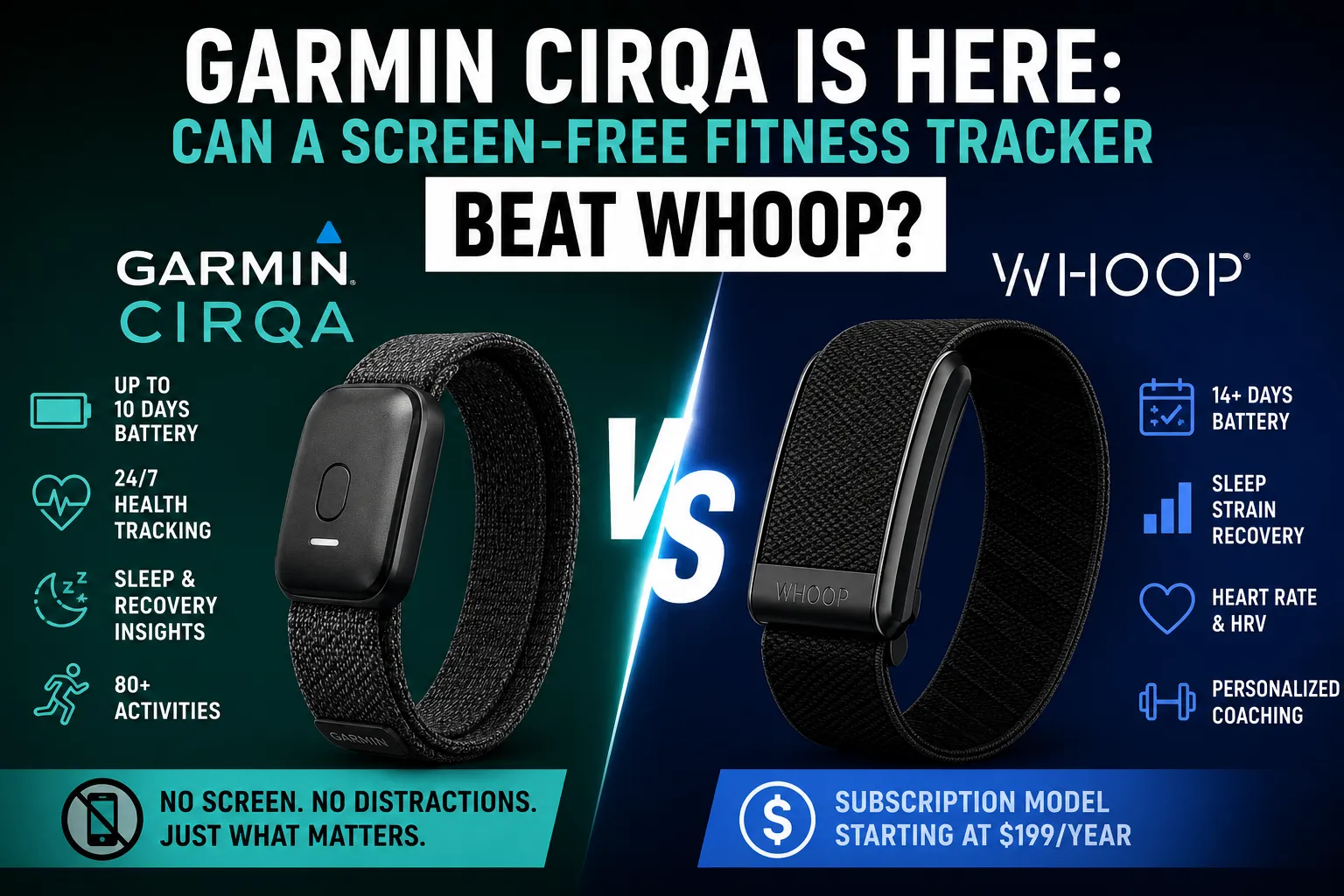

Garmin CIRQA Is Here: Can a Screen-Free Fitness Tracker Beat Whoop?
For years, Whoop has largely owned the idea of a fitness tracker that deliberately stays out of your way.
There is no traditional watch display demanding attention, no stream of notifications lighting up your wrist and no temptation to constantly check your heart rate during a workout. Instead, the device quietly collects data while the user turns to an app later for insights about sleep, recovery, strain and fitness.
Now Garmin wants a piece of that market.
The company has launched CIRQA Smart Band, its first screen-free fitness tracker, putting it directly up against Whoop and other minimalist wearables. Priced at $199.99 in the U.S., CIRQA combines continuous health monitoring, fitness tracking, sleep analysis and Garmin’s broader ecosystem without requiring a subscription for its core features.
That creates an intriguing contest.
Can Garmin’s no-screen approach deliver enough of Whoop’s training intelligence while avoiding the recurring membership cost?
What exactly is Garmin CIRQA?
CIRQA is not a smartwatch with its display removed.
It is designed from the beginning as a discreet, screen-free health and fitness tracker. The device can be worn around the wrist or upper arm and uses a fabric band with a small sensor module.
There is a physical button on the device for starting activities, while most of the information is viewed later through the Garmin Connect app.
Garmin says CIRQA can provide up to 10 days of battery life, automatically detect a range of activities and monitor health around the clock. Its feature set includes sleep tracking, Sleep Score, Training Readiness, stress tracking, Body Battery, Pulse Ox and women’s health features.
The concept is deliberately simple:
Track now. Look later.
That is increasingly appealing in a wearable market where users can already feel overwhelmed by notifications, screens and constant data. The broader role of wearables in modern exercise is explored in wearable fitness technology and the rise of connected fitness.
Why Garmin is challenging Whoop
The most obvious reason is the business model.
CIRQA costs $199.99 and does not require a subscription to access its core health and fitness tracking. Garmin does offer additional features through Garmin Connect+, but the basic CIRQA experience does not depend on paying a recurring membership fee.
Whoop takes a different approach.
As of August 2026, WHOOP’s entry-level One membership costs $199 per year and includes the WHOOP 5.0, with Sleep, Strain, Recovery, VO₂ Max, heart-rate zones and personalized coaching. Higher tiers cost $239 and $359 per year and add features such as Healthspan, health alerts, real-time stress monitoring and additional heart-health capabilities.
The difference becomes substantial over several years.
A $199 CIRQA purchase can potentially remain useful without another annual payment for the core tracking experience. A WHOOP user is effectively committing to an ongoing membership.
That makes CIRQA’s value proposition unusually straightforward:
Buy the tracker once and keep using Garmin’s ecosystem without paying a mandatory annual fee.
CIRQA vs. Whoop: The key differences
| Feature | Garmin CIRQA | WHOOP 5.0 |
|---|---|---|
| Display | No screen | No screen |
| Starting price | $199.99 | $199/year membership |
| Subscription required for core tracking | No | Yes |
| Battery | Up to 10 days | 14+ days |
| Sleep tracking | Yes | Yes |
| Recovery insights | Training Readiness | Recovery |
| Fitness tracking | 80+ activities | 45 auto-detected activities, plus broader activity support |
| Heart-rate monitoring | Yes | Yes |
| GPS | Connected GPS via phone | Phone-based GPS options |
| Smartphone platform | Garmin Connect | WHOOP app |
| Physical activity button | Yes | No traditional physical display/button interaction |
| Broader ecosystem | Garmin watches and services | WHOOP health and performance platform |
The specifications tell only part of the story.
The more important difference is how each company interprets the data.
Whoop still has a major advantage in coaching
Whoop has spent years building its product around the relationship between Sleep, Strain and Recovery.
Rather than simply presenting a collection of measurements, the platform attempts to turn those measurements into daily recommendations.
Its newer membership structure also extends into areas such as Healthspan, stress monitoring, heart health and AI-powered guidance. WHOOP says its AI coaching uses personal biometric information and user-provided context to generate more individualized recommendations.
This is important because raw data is not necessarily useful by itself.
Knowing that your resting heart rate changed slightly may not tell you what to do.
A system that can combine that information with sleep, recent training and recovery trends can potentially provide a more useful answer.
Whoop has made that interpretation central to its identity.
Garmin, however, is hardly a newcomer to fitness analytics.
Garmin brings a much larger fitness ecosystem
CIRQA’s biggest advantage may not be the band itself.
It is Garmin Connect.
Garmin has spent decades building products for runners, cyclists, swimmers, hikers, triathletes and other athletes. Its ecosystem includes GPS watches, cycling computers, sports sensors and other fitness devices.
That gives CIRQA an unusual advantage for people who already use Garmin hardware.
The company says CIRQA can complement existing Garmin devices, allowing users to move between devices while maintaining access to their health and fitness data.
Garmin’s broader wearable strategy is also expanding, with the company’s next major fitness wearable launch showing how the company continues developing its fitness hardware ecosystem.
For a Garmin user, CIRQA is therefore not necessarily a replacement for a sports watch.
It can be a second wearable designed for periods when wearing a full smartwatch feels unnecessary.
That could be particularly attractive overnight.
The screen-free design is the whole point
At first glance, removing a screen from a fitness tracker might seem like taking away one of its most useful features.
But that is exactly the appeal.
A traditional smartwatch constantly gives you information.
CIRQA intentionally does not.
You cannot glance at your wrist to see your heart rate, notifications, weather or workout statistics.
Instead, you are encouraged to exercise, sleep or go about your day without constantly checking the device.
Garmin explicitly positions CIRQA as a distraction-free product designed to let users access their data later through Garmin Connect.
That philosophy is increasingly relevant as wearable technology becomes more capable.
More features can sometimes mean more interruptions.
A screen-free tracker takes the opposite approach:
Collect the information without constantly displaying it.
Battery life is good, but Whoop wins here
Garmin rates CIRQA for up to 10 days between charges.
That is respectable for a continuous health tracker and substantially longer than many conventional smartwatches.
But Whoop 5.0 currently claims 14+ days of battery life.
Battery life matters more for screen-free trackers than it might appear.
The whole point is to wear the device continuously.
If you frequently remove it to charge, the resulting gaps can reduce the usefulness of long-term health and sleep trends.
CIRQA therefore does well, but Whoop retains an advantage in this category.
Garmin has one clever feature Whoop doesn’t
CIRQA includes a physical button.
That sounds insignificant until you consider what a screen-free device normally requires.
Without a display, users need another way to interact with the tracker.
Garmin’s button can be used to start and stop workouts and control activity tracking. Garmin says CIRQA can track more than 80 activities, with activities also automatically detected in many situations.
This is a practical advantage.
You do not necessarily have to pull out your phone simply to tell the tracker that you are starting an exercise session.
It is a small piece of hardware design that makes a screenless device more functional.
CIRQA’s biggest weakness may be the lack of built-in GPS
There is an important limitation for runners and cyclists.
CIRQA does not have standalone GPS.
Instead, it uses connected GPS through a paired smartphone when route tracking is required.
That means someone going for a run who wants a mapped route still needs to bring a compatible phone.
For people who already own a Garmin GPS watch, this may not matter at all.
For someone buying CIRQA as their only fitness device, however, it is worth considering.
A screen-free tracker that cannot independently record a GPS route is less capable for outdoor athletes than a dedicated Garmin sports watch.
Early testing suggests CIRQA is more than a wellness gadget
Initial hands-on and review testing has generally been encouraging.
TechRadar tested CIRQA’s heart-rate accuracy against a Polar H10 chest strap and reported that the Garmin performed very well, with some minor outliers.
The Wall Street Journal similarly found the device’s heart-rate tracking reliable, particularly when worn on the upper arm, while praising its integration with Garmin’s ecosystem and lack of a required subscription.
That matters because the usefulness of recovery and training metrics depends on the quality of the underlying measurements.
If the sensors produce unreliable data, sophisticated algorithms cannot completely rescue the experience.
The importance of recovery data is part of a much broader fitness trend, as recovery tracking becomes an increasingly important part of modern fitness.
But CIRQA isn’t perfect
Early reviews have also identified some clear compromises.
One recurring criticism is the physical design.
CIRQA is minimalist in function, but it is not necessarily the smallest or most discreet screen-free tracker available. Tom’s Guide’s testing found the band somewhat bulky and uncomfortable for some smaller wrists, and noted that the fabric can retain moisture after getting wet.
The device can also feel less immediately intuitive than a traditional Garmin watch.
There is no display showing your current workout statistics, so users accustomed to checking pace, heart rate or distance directly from their wrist will need to change their habits.
That is not a flaw in the conventional sense.
It is a consequence of the product’s central design philosophy.
Whoop remains stronger for serious recovery-focused athletes
Whoop’s greatest advantage is maturity.
The company has built its entire product around continuous physiological monitoring and recovery.
Its current platform offers Sleep, Strain and Recovery insights alongside VO₂ Max, heart-rate zones, personalized coaching and other health features. Higher membership tiers add Healthspan, stress monitoring and additional heart-related capabilities.
WHOOP has also continued improving automatic activity detection and says its system can recognize 45 activity types automatically.
For athletes who want the most developed coaching-oriented experience and are comfortable paying for it, Whoop remains a formidable competitor.
CIRQA is not obviously designed to destroy that proposition.
Instead, Garmin is offering an alternative philosophy.
CIRQA may be the better choice for Garmin users
If you already own a Garmin watch, the argument becomes much stronger.
You can use CIRQA when you want something lighter and less distracting, while keeping your Garmin ecosystem.
For example, someone might use a Forerunner or Fenix for structured training and GPS workouts, then wear CIRQA during sleep, travel or everyday activities.
The two products can serve different purposes.
This is one area where Garmin’s broader ecosystem could prove difficult for Whoop to counter.
Garmin is not simply selling another tracker.
It is adding another piece to an existing network of fitness products and health data.
CIRQA is also compelling for people who hate subscriptions
The subscription question could ultimately become one of CIRQA’s biggest selling points.
Consumers are increasingly paying monthly or annual fees for software, entertainment, cloud storage and connected hardware.
Fitness tracking adds another potential recurring cost.
CIRQA’s approach is refreshing because its core capabilities are available without a mandatory membership.
By contrast, WHOOP’s current model bundles its hardware with a paid membership, starting at $199 per year for WHOOP One.
Over three years, that difference becomes substantial.
Someone paying $199 per year for WHOOP One would spend roughly $597 over three years, before considering taxes or changes to pricing.
A $199 CIRQA does not create the same recurring commitment for its core tracking features.
For cost-conscious buyers, that is difficult to ignore.
Who should buy Garmin CIRQA?
CIRQA makes the most sense for people who:
- Want a screen-free wearable
- Do not want a mandatory subscription
- Already use Garmin products
- Care about sleep and recovery tracking
- Want long battery life
- Prefer to check data later rather than constantly
- Want a tracker that can be worn on the wrist or upper arm
- Do not need standalone GPS
- Want access to Garmin’s broader fitness ecosystem
It is particularly compelling for someone who wants Garmin data without wearing a Garmin smartwatch all day.
Who should stick with Whoop?
Whoop remains attractive for people who:
- Prioritize recovery and training analytics
- Want a highly developed coaching platform
- Like the Sleep/Strain/Recovery framework
- Want 14+ days of battery life
- Are comfortable with a membership model
- Want Whoop’s expanding health and longevity features
- Prefer a mature screen-free fitness ecosystem
The subscription is a significant downside, but it funds a platform that continues to add software and coaching capabilities.
That distinction is important.
You are not simply paying for the hardware.
You are paying for an ongoing service.
The bigger trend: fitness trackers are becoming quieter
The competition between CIRQA and Whoop reflects a broader change in wearable technology.
For years, manufacturers competed to put more information on your wrist.
Bigger screens.
More notifications.
More apps.
More health measurements.
More smart features.
Screen-free trackers are moving in the opposite direction.
They assume that people do not necessarily need to see everything immediately.
Instead, the wearable becomes a passive sensor that collects information while the smartphone app becomes the place where users interpret it.
This shift also connects with the wider growth of mobile fitness apps and their role in at-home exercise.
That could become one of the most interesting trends in fitness technology.
So, can Garmin CIRQA beat Whoop?
Yes—but probably not by beating Whoop at its own game.
Whoop remains the more established recovery-first platform, with a strong coaching system, extensive longitudinal data and a growing collection of health and performance features. Its 14+ day battery also gives it an edge for continuous wear.
CIRQA’s argument is different.
It offers Garmin’s fitness ecosystem, a screen-free design, up to 10 days of battery life, a physical activity button and substantial health tracking without requiring a subscription for its core features.
That makes it less of a Whoop killer and more of a serious alternative.
For a dedicated Whoop user who loves the company’s coaching system, switching may not make much sense.
For a Garmin owner, a subscription-weary athlete or someone who simply wants continuous health tracking without another screen demanding attention, CIRQA could be the more attractive proposition.
And that may be Garmin’s smartest move.
The company does not need to convince everyone to abandon Whoop. It only needs to convince enough people that fitness data is worth collecting—but it does not need to live on your wrist as a constant stream of information.
Continue Reading
Similar Posts
Walking Faster May Matter More Than Hitting 10,000 Steps, New Study Finds
A large U.S. study found that even relatively short periods of fast walking were associated with lower mortality risk, while newer research has also found that higher stepping intensity can be associated with better cardiovascular outcomes.
Read article
Apple Watch Series 12 Arrives With New Fitness and Health Tracking Features
The launch reflects a broader shift in wearable technology. Smartwatches are increasingly moving beyond simple step counts and workout timers toward tools that combine activity, sleep, cardiovascular measurements, and recovery information into a broader picture of personal fitness.
Read article
Just 3 Minutes of Intense Exercise Could Trigger Powerful Health-Related Changes, Study Finds
That does not mean three minutes of sprinting has been proven to replace a longer workout. Instead, the findings offer a closer look at why intense exercise may produce such a rapid and wide-ranging biological response.
Read article

Join 10,000+ Readers Building Healthier Habits
Get actionable wellness tips every week plus our newest articles delivered straight to your inbox.