
Four Areas of Fitness Linked to Longer Life After 65, Study Finds
Staying physically fit after 65 may involve more than simply walking regularly or maintaining a certain number on the scale. New research suggests that several distinct areas of physical fitness are associated with a lower risk of death among older adults.
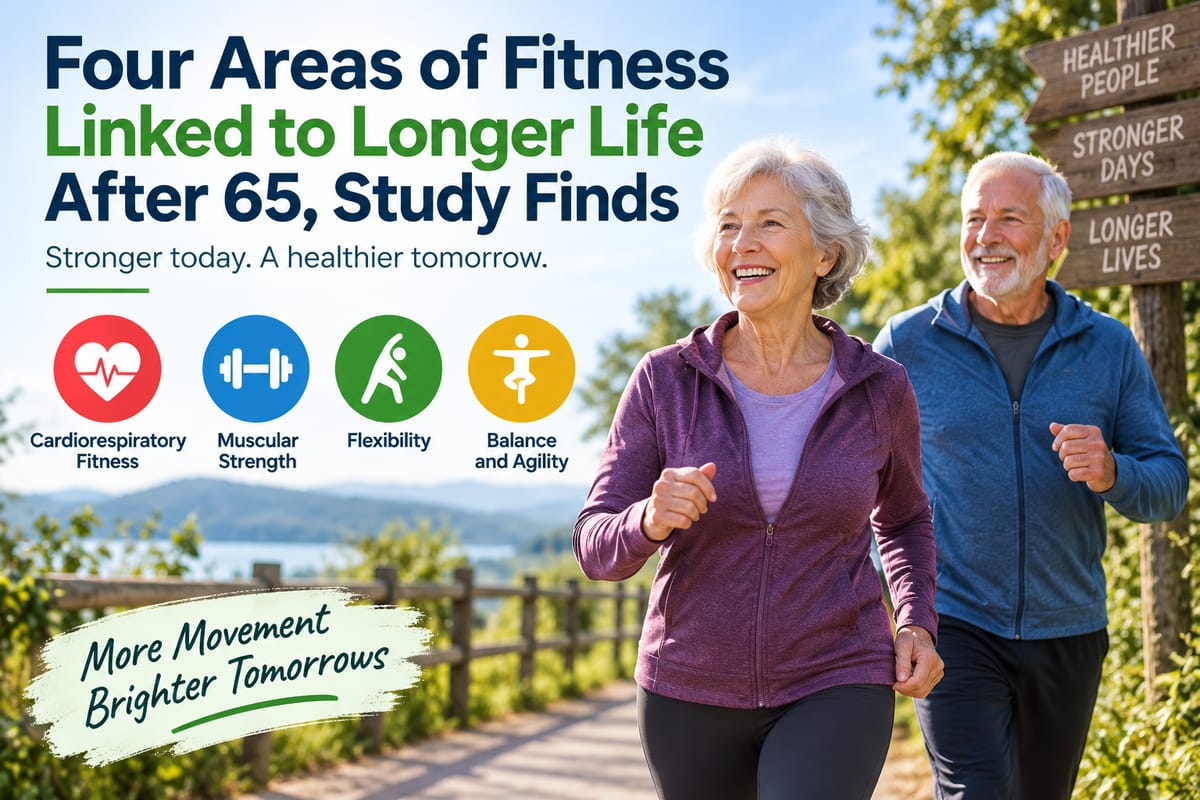
A study published in JAMA Network Open examined more than 13,000 adults aged 65 and older in Taiwan and found that higher performance across several fitness measures was associated with lower all-cause mortality during a median follow-up of seven years. The researchers assessed four broad areas: cardiorespiratory fitness, muscular strength, flexibility, and balance and agility.
Among the individual tests, balance and agility, lower-body strength, and cardiorespiratory fitness showed particularly strong associations with survival.
The findings do not mean that improving one fitness skill guarantees a longer life. The research was observational, so it cannot establish that better fitness directly caused the lower mortality risk. Instead, it adds to evidence that physical function can provide important information about health and resilience as people age.
The Four Areas Researchers Examined
The researchers used standardized fitness assessments based on the Senior Fitness Test protocol. Participants completed seven individual tests covering four areas of physical capability.
These included:
- Cardiorespiratory fitness: assessed using a two-minute step test.
- Muscular strength: measured with chair stands and arm curls.
- Flexibility: assessed through back-scratch and chair sit-and-reach tests.
- Balance and agility: measured with a one-leg stance and an eight-foot up-and-go test.
This multidimensional approach is important because fitness is not a single trait.
Someone may have good endurance but poor balance. Another person may have strong legs but limited flexibility. Someone else may be able to walk for a long period but struggle to rise from a chair without using their arms.
The study suggests that looking at several dimensions together can provide a more complete picture of physical function.
Balance and Agility Stand Out
Balance and agility were among the strongest areas associated with lower mortality in the study.
Participants performed an eight-foot up-and-go test, which measures how quickly a person can stand from a chair, walk a short distance, turn around, return and sit down. They also completed a one-leg stance test.
Compared with participants in the lowest performance group, those in the highest group for the eight-foot up-and-go test had an adjusted hazard ratio of 0.41 for all-cause mortality. For the one-leg stance test, the adjusted hazard ratio was 0.50.
These numbers describe statistical associations rather than guarantees about individual outcomes.
Balance and agility are particularly relevant to everyday independence because many ordinary activities require a combination of stability, coordination and the ability to change direction safely.
Walking around a home, stepping over an obstacle, getting out of a chair or navigating uneven ground can all require these abilities.
Lower-Body Strength Matters for Everyday Function
The second major area highlighted by the research was muscular strength, particularly strength in the lower body.
Researchers used the 30-second chair-stand test to assess this capability. Participants repeatedly stood up from a chair without using their arms.
Those in the highest performance group had a 0.55 adjusted hazard ratio for all-cause mortality compared with those in the lowest group.
Lower-body strength has obvious practical importance as people age.
Strong legs and hips can support everyday movements such as climbing stairs, standing from a chair, getting out of a vehicle and walking through the community.
Strength also contributes to maintaining physical independence. Losing strength can make ordinary tasks progressively more difficult, which can reduce activity levels and create a cycle of declining physical function.
The relationship between resistance exercise and long-term health is explored further in Strength Training vs Cardio: Which Is Better for Long-Term Health?.
Cardiorespiratory Fitness Is Another Key Piece
Cardiorespiratory fitness was the third area strongly associated with lower mortality.
The study measured this using a two-minute step test, in which participants repeatedly raised their knees to a specified height while remaining in place.
Participants with the highest performance had an adjusted hazard ratio of 0.58 compared with those in the lowest performance group.
Cardiorespiratory fitness reflects the body’s ability to sustain physical activity and deliver oxygen to working muscles.
Activities such as brisk walking, cycling, swimming and dancing can challenge the cardiovascular and respiratory systems while also contributing to general mobility.
Recent research has continued to examine the relationship between aerobic activity, cardiorespiratory fitness and health outcomes among older adults. A 2026 systematic review covering 94 studies found evidence linking aerobic physical activity and cardiorespiratory fitness with several health outcomes in adults aged 65 and older.
More detail on the subject can be found in How Aerobic Exercise Supports Cardiovascular Health.
Flexibility Was Part of the Picture Too
Flexibility was the fourth fitness domain examined in the study.
Researchers used back-scratch and chair sit-and-reach tests to assess flexibility in different parts of the body.
The association with mortality was weaker than for some of the other individual measures. For example, the chair sit-and-reach test produced an adjusted hazard ratio of 0.79 when comparing the highest and lowest performance groups.
That does not make flexibility unimportant.
The ability to move joints through an adequate range of motion can make everyday movements easier and may contribute to overall physical function. Flexibility can also complement strength, balance and aerobic activity rather than existing as a completely separate goal.
The findings simply suggest that the relationship between individual fitness measures and mortality differs across domains.
Fitness Was Associated With Mortality Across the Group
The study included 13,423 community-dwelling adults with an average age of about 73 years. About 62.5% were women.
During the median seven-year follow-up, 1,631 participants, or 12.2%, died. Researchers adjusted their analyses for demographic factors, existing health conditions and self-reported physical activity.
When researchers combined performance across all seven tests into an overall fitness index, participants in the highest performance group had an adjusted hazard ratio of 0.39 compared with those in the lowest group.
Again, this should not be interpreted as proof that achieving a particular fitness score will produce a specific change in lifespan.
Instead, the results indicate a consistent statistical relationship between better physical function and lower mortality risk.
Men and Women Showed Some Differences
The researchers also found differences in which fitness measures had the strongest associations when men and women were analyzed separately.
Among men, balance and agility remained particularly strongly associated with mortality, followed by cardiorespiratory fitness.
Among women, lower-body strength showed a particularly strong association, with balance and agility also remaining important.
These differences do not mean that one type of exercise should be reserved for one sex.
Rather, they demonstrate that physical fitness is influenced by multiple factors and that maintaining several aspects of physical function may be more useful than concentrating exclusively on a single measurement.
Why Functional Fitness Matters After 65
Fitness can become increasingly important for maintaining independence as people get older.
Everyday life requires movement. Getting dressed, shopping, preparing food, climbing stairs, carrying objects and moving around the home all depend on some combination of strength, balance, endurance and mobility.
A decline in one area can make other activities harder.
For example, weaker legs can make walking more difficult. Reduced activity can then lead to further losses in strength and endurance. Poor balance can make people more cautious about moving, potentially reducing activity even further.
Maintaining a broad base of physical capability can therefore support continued participation in everyday activities.
The Findings Support a Multidimensional Approach to Exercise
The research also reinforces why exercise plans do not necessarily need to focus on only one type of activity.
A routine that combines aerobic movement, resistance training, balance work and mobility exercises addresses different aspects of physical function.
Walking may challenge endurance. Strength exercises can target the legs and upper body. Balance exercises can challenge stability and coordination. Gentle mobility work can help maintain movement through useful ranges.
The Complete Guide to Physical Activity and Exercise provides a broader look at how different forms of movement can fit into an overall approach to physical activity.
Simple Activities Can Support Multiple Fitness Areas
Exercise does not necessarily have to involve complicated equipment.
Brisk walking can challenge cardiorespiratory fitness while also requiring balance and coordination. Sit-to-stand exercises can develop lower-body strength. Step-ups can combine leg strength with cardiovascular work. Simple balance drills can challenge stability.
The appropriate activity depends on a person’s current abilities, health, previous injuries and goals.
For older adults who are inactive or have significant balance problems, starting gradually and getting professional guidance may be appropriate before introducing more demanding exercises.
The objective is not to reproduce the exact tests used in the research as a daily workout.
The tests were designed to measure physical capability, not necessarily to serve as a complete exercise program.
Fitness Is Only One Part of Healthy Aging
The study focused on physical fitness and mortality, but longevity and healthy aging are influenced by many factors.
Diet, sleep, smoking, alcohol use, social connection, medical conditions, access to health care and socioeconomic circumstances can all affect health outcomes.
The researchers adjusted for several factors in their statistical analysis, but observational studies cannot account perfectly for every possible influence.
That is why the findings are best understood as evidence of an association rather than proof of a direct cause-and-effect relationship.
The broader principles behind maintaining physical function are also discussed in How Healthy Habits Support Healthy Aging.
What the Study Could Mean for Older Adults
One of the study’s more practical implications is that simple physical assessments could potentially provide useful information about an older person’s functional capacity.
A chair-stand test, walking-related agility assessment or balance test can reveal aspects of physical function that may not be obvious from a list of medical diagnoses alone.
The researchers suggested that incorporating objective fitness assessments into routine geriatric and internal-medicine care could improve risk assessment and help guide individualized strategies aimed at preserving function and independence.
That approach shifts some attention from simply asking whether someone has a particular disease to also asking what they can physically do.
Building Fitness Across the Years
The new findings reinforce a broader message about aging: physical capability involves more than endurance alone.
Balance and agility, lower-body strength, cardiorespiratory fitness and flexibility all contribute to the way people move through everyday life. In the 2026 Taiwanese cohort, stronger performance across these domains was associated with lower all-cause mortality, with the strongest associations seen for balance and agility, lower-body strength and cardiorespiratory fitness.
For people approaching or already beyond 65, the findings provide another reason to view exercise as a long-term investment in physical function rather than simply a way to burn calories.
Maintaining the ability to stand, walk, balance, move comfortably and sustain activity can help preserve independence—and the latest research suggests that these capabilities are closely connected with broader health outcomes in later life.
Continue Reading
Similar Posts

HHS Launches $10 Million Presidential Fitness Challenge for Schools and Youth Programs
Announced October 1 at Westlake High School in Austin, Texas, the initiative is designed to encourage organizations to implement the revived Presidential Fitness Test while creating positive experiences that can help children develop long-term exercise habits.
Read article
Peloton Tread Flex Launches October 1 as AI-Powered Running Enters a New Phase
Together, the hardware and software changes signal a broader shift in how connected fitness equipment can support runners. Instead of simply displaying workouts, newer machines are increasingly designed to interpret performance data and adapt the training experience around the individual.
Read article
Retatrutide Weight-Loss Results Put Exercise and Muscle Preservation Back in Focus
Those results make retatrutide an important development in obesity medicine. They also reinforce a broader lesson about weight management: **a successful outcome cannot be measured by the number on the scale alone.**
Read article

Join 10,000+ Readers Building Healthier Habits
Get actionable wellness tips every week plus our newest articles delivered straight to your inbox.