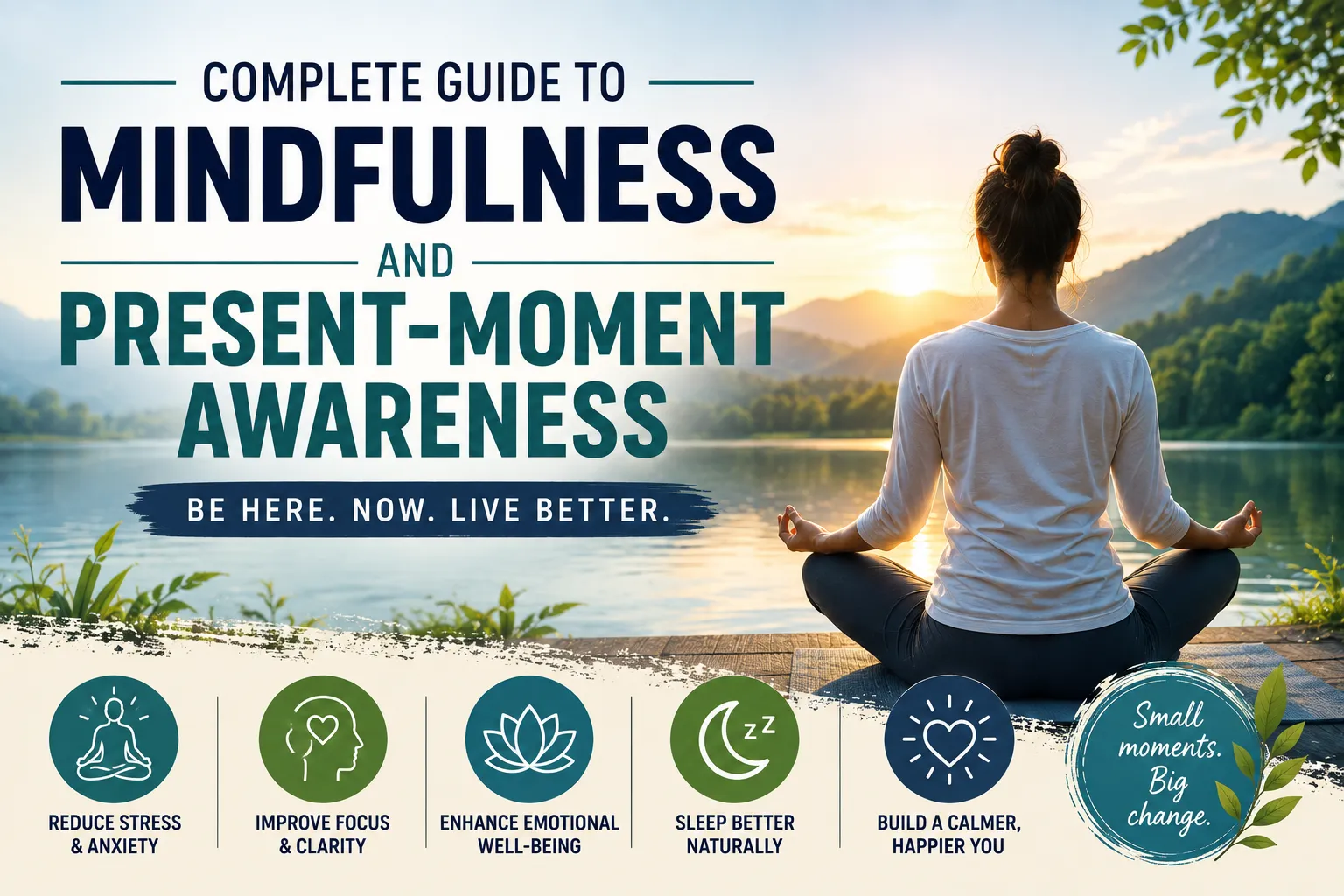

Complete Guide to Mindfulness and Present-Moment Awareness
Modern life can make it surprisingly difficult to stay focused on what is happening right now. Notifications compete for attention, work can follow people home, and worries about the future or regrets about the past can occupy much of the day.
Mindfulness offers a different approach. Rather than trying to eliminate thoughts or emotions, mindfulness involves deliberately paying attention to the present moment with openness and without immediately judging what is happening.
It is a practice that can be incorporated into meditation, everyday activities, conversations, exercise, meals, or even a few quiet breaths during a busy day.
Research suggests that mindfulness-based practices may help with stress, anxiety, depression symptoms and sleep, although the strength of evidence varies depending on the specific practice and health outcome. Mindfulness can therefore be viewed as one part of a broader approach to emotional health, alongside other practices discussed in The Complete Guide to Emotional Well-Being.
What Is Mindfulness?
Mindfulness is the practice of maintaining awareness of the present moment without automatically judging or reacting to the experience.
That experience could be almost anything: breathing, sounds, physical sensations, thoughts, emotions, movement or the environment around you.
For example, while drinking a cup of tea, a person practicing mindfulness might notice the temperature of the cup, the aroma, the taste, the sensation of swallowing and the thoughts that arise.
The objective is not to force the mind to become completely silent.
Instead, mindfulness encourages people to notice where their attention has gone and gently bring it back to the current experience.
What Does Present-Moment Awareness Mean?
Present-moment awareness is closely connected to mindfulness.
It means consciously noticing what is happening now rather than becoming completely absorbed in memories, predictions or automatic thoughts.
Everyone’s mind naturally wanders. Thinking about yesterday’s conversation or tomorrow’s responsibilities is not inherently a problem.
The difficulty can arise when attention becomes trapped in repetitive thinking.
Mindfulness provides a way to recognize that mental shift.
Instead of automatically following every thought, you can notice it and return your attention to whatever you are actually doing.
Mindfulness Is Not About Stopping Thoughts
One of the most common misconceptions about mindfulness is that successful meditation requires an empty mind.
It does not.
Thoughts will naturally appear during mindfulness practice. A person might think about work, family, money, food, an upcoming appointment or something that happened years ago.
The practice is to recognize that the thought has appeared without becoming completely absorbed in it.
A simple mental process might look like this:
Notice → acknowledge → redirect attention → continue.
For example, you might notice yourself thinking about an unfinished task while practicing breathing exercises. Instead of criticizing yourself for losing focus, you acknowledge the thought and gently return attention to your breathing.
Over time, repeatedly practicing this process can make it easier to recognize distractions.
How Mindfulness Works
Mindfulness involves several related skills.
Attention
Mindfulness requires deliberately directing attention toward something in the present.
This could be the breath, sounds, physical sensations or an everyday activity.
Awareness
The practitioner becomes more aware of thoughts, emotions and sensations as they arise.
Nonjudgment
Instead of immediately labeling an experience as good, bad, embarrassing or threatening, mindfulness encourages observation.
Acceptance
Acceptance does not mean approving of something unpleasant or refusing to change it.
It means acknowledging the experience as it is before deciding how to respond.
Returning Attention
When attention wanders, the practitioner brings it back.
This repeated return is a central part of many mindfulness practices.
Learning to recognize emotions without immediately reacting to them can also support emotional regulation in everyday life, where awareness becomes an important part of choosing how to respond.
Potential Benefits of Mindfulness
Mindfulness is often discussed as a general wellness practice, but researchers have also studied its potential effects on specific aspects of mental and physical health.
The evidence is encouraging in some areas but should not be overstated.
Stress Management
Mindfulness may help people manage symptoms associated with stress.
Research summarized by the National Center for Complementary and Integrative Health indicates that mindfulness meditation may help reduce symptoms of stress, including anxiety and depression, and may also improve sleep.
One possible reason is that mindfulness encourages people to notice stressful thoughts and physical reactions without automatically escalating them.
Instead of immediately reacting to a stressful thought, someone may learn to pause, observe the reaction and choose what to do next.
Mindfulness can therefore complement broader strategies described in The Complete Guide to Stress Management, particularly when stress becomes a recurring part of everyday life.
Anxiety
Mindfulness-based approaches have been studied as tools for managing anxiety.
Research has found that mindfulness-based practices can be helpful for anxiety, although results differ between studies and approaches.
Mindfulness should not be viewed as a guaranteed cure for anxiety. People experiencing persistent or severe anxiety may need professional assessment and evidence-based treatment.
For people looking for a broader set of practical strategies, the Anxiety Management Guide explores additional approaches for managing anxiety and related symptoms.
Mood and Depression
Mindfulness-based approaches have also been studied in relation to depression.
Analyses of research have found mindfulness-based approaches can be better than no treatment for anxiety and depression and may perform similarly to some established therapies in certain research settings. However, evidence quality and long-term outcomes vary.
This is one reason mindfulness is often incorporated into structured approaches such as mindfulness-based cognitive therapy.
Sleep
Difficulty switching off at night is a common reason people become interested in mindfulness.
Research suggests mindfulness meditation may improve sleep quality and may help reduce insomnia symptoms for some people.
However, persistent insomnia can have many causes, and mindfulness should not replace appropriate medical or behavioral treatment when sleep problems continue.
Emotional Awareness
Mindfulness can also encourage greater awareness of emotions.
Instead of immediately reacting to anger, frustration or sadness, a person can learn to identify the emotion and notice how it appears in the body.
That extra awareness can create a small space between an emotional reaction and a response.
For some people, that pause can be valuable in relationships, work and stressful situations.
Common Types of Mindfulness Practice
Mindfulness does not have to mean sitting still for long periods.
There are many ways to practice.
Mindful Breathing
This is one of the simplest approaches.
Sit comfortably and pay attention to your natural breathing.
Notice the movement of the abdomen or chest, the sensation of air moving through the nose and the rhythm of each breath.
When your attention wanders, gently return it to breathing.
Body Scan Meditation
A body scan involves directing attention gradually through different parts of the body.
You might begin with the feet and slowly move upward, noticing sensations such as pressure, warmth, tension or relaxation.
The goal is observation rather than trying to force particular sensations to disappear.
Mindful Walking
Mindfulness can be practiced while walking.
Pay attention to the movement of the legs and feet, the contact between your body and the ground, your breathing and the surrounding environment.
There is no need to walk unusually slowly unless that helps you focus.
Mindful Eating
Eating can become an automatic activity, especially when people eat while watching television, working or using their phones.
Mindful eating involves paying attention to the appearance, smell, texture and taste of food, as well as hunger and fullness cues.
Everyday Mindfulness
Almost any routine activity can become a mindfulness exercise.
Washing dishes, showering, brushing your teeth or preparing food can become opportunities to practice present-moment attention.
The key is to actually notice the experience rather than performing the activity entirely on autopilot.
A Simple Mindfulness Exercise for Beginners
A beginner does not need an elaborate meditation setup.
Try this five-minute exercise:
-
Sit comfortably. Choose a position that allows you to remain reasonably alert.
-
Notice your surroundings. Take a moment to become aware of where you are.
-
Focus on breathing. Notice the natural movement of each breath.
-
Observe distractions. When thoughts appear, recognize them without criticizing yourself.
-
Return to the breath. Gently redirect your attention.
-
Notice your body. Pay attention to sensations such as tension, warmth or contact with the chair.
-
Finish gradually. Notice the room around you before returning to your normal activities.
If your attention wanders dozens of times, that does not mean you have failed.
Each time you notice the distraction and return your attention, you are practicing the skill.
How Long Should You Practice Mindfulness?
There is no universal amount of time that everyone needs.
Beginners may find it easier to start with a few minutes rather than attempting a lengthy meditation session immediately.
Consistency can be more practical than setting an unrealistic goal.
Someone who practices for five minutes regularly may find the habit easier to maintain than someone who attempts an hour once and then stops.
As the practice becomes familiar, some people choose to increase the duration or explore structured mindfulness programs.
Mindfulness in Everyday Life
One of the most useful aspects of mindfulness is that it does not have to remain separate from ordinary life.
During Conversations
Instead of planning your response while someone else is speaking, try giving the person your full attention.
Notice their words, tone and expressions.
This kind of awareness can also support healthy relationships, communication, boundaries and trust.
While Working
When completing an important task, reduce unnecessary distractions and periodically notice whether your attention has moved elsewhere.
During Exercise
Pay attention to breathing, movement, muscle sensations and surroundings rather than spending the entire workout lost in unrelated thoughts.
During Stressful Moments
Before responding to a difficult situation, pause for a few breaths and notice what you are experiencing.
That pause can help create an opportunity for a more deliberate response.
For people dealing with ongoing pressures, mindfulness can also be paired with practical healthy coping skills that help manage difficult emotions and everyday challenges.
Common Mindfulness Mistakes
Expecting Immediate Results
Mindfulness is a skill rather than a quick mental reset.
Some people notice benefits quickly, while others may need regular practice before they find it useful.
Trying Too Hard to Relax
Mindfulness is not necessarily about feeling calm.
Sometimes the present moment includes anxiety, frustration, boredom or physical discomfort.
The practice is to notice the experience rather than forcing yourself to feel differently.
Judging Yourself for Losing Focus
A wandering mind is normal.
Beating yourself up for becoming distracted can turn mindfulness into another source of stress.
Treating Mindfulness as a Cure-All
Mindfulness can be useful, but it is not a substitute for every form of healthcare.
Evidence varies considerably depending on the condition and the specific mindfulness intervention being studied.
Practicing Only When You Are Stressed
Mindfulness can be particularly useful during stressful periods, but building the habit during ordinary moments may make it easier to use when difficulties arise.
Is Mindfulness Safe for Everyone?
Meditation and mindfulness practices are generally considered to have few risks, but they are not completely risk-free.
Research has found that some people report negative experiences, with anxiety and depression among the effects reported in research.
People who experience significant distress during meditation should not assume they simply need to push through it.
Stopping the practice, modifying the approach or discussing the experience with an appropriately qualified healthcare professional may be appropriate.
Mindfulness also should not be used to delay professional care for serious mental or physical health problems.
Mindfulness and Professional Mental Health Care
Mindfulness can complement professional mental health care, particularly when incorporated into structured, evidence-based programs.
For example, mindfulness-based cognitive therapy combines mindfulness practices with elements of cognitive behavioral therapy, while mindfulness-based stress reduction uses meditation alongside education and other strategies for managing stressful experiences.
For someone experiencing persistent depression, severe anxiety, trauma-related symptoms or other significant mental health difficulties, professional assessment remains important.
Mindfulness can be one tool within a broader approach rather than a replacement for appropriate treatment.
Building a Sustainable Mindfulness Habit
The most practical approach is usually the one that fits naturally into your life.
Start small.
Choose a consistent time of day and a simple practice. You could spend five minutes focusing on your breathing after waking up, practice mindful walking during part of a daily walk, or spend a few minutes paying attention to your surroundings before bed.
It can also help to connect mindfulness with an existing habit.
For example:
After making your morning coffee → practice two minutes of mindful breathing.
Over time, the activity becomes associated with an established routine.
The goal is not perfection. It is developing the ability to notice where your attention is and consciously decide where to place it.
The Skill of Coming Back to Now
Mindfulness is ultimately less about escaping thoughts than changing your relationship with them.
The mind will wander. Plans will need to be made. Memories will appear. Emotions will come and go.
Present-moment awareness provides a simple skill for recognizing those experiences without automatically becoming consumed by them.
Whether practiced through meditation, mindful movement, everyday activities or brief breathing exercises, mindfulness can become a practical way of paying closer attention to life as it happens.
The evidence suggests potential benefits for areas such as stress, anxiety, mood and sleep, while also making clear that mindfulness is not a universal treatment and that more research is needed for many specific health claims.
For beginners, the most useful place to start may be surprisingly simple: pause, notice what is happening right now, and gently bring your attention back when it wanders.
Continue Reading
Similar Posts

How to Provide Emotional Support to Others
Good emotional support is also about respecting boundaries. People need different kinds of help at different times. Some may want to talk, while others may need practical assistance, quiet companionship, or simply reassurance that someone cares.
Read article
How Stress Affects Concentration and Memory
Understanding the connection between stress, concentration and memory can help explain why the mind sometimes feels less efficient during stressful periods—and why managing stress can be an important part of maintaining overall mental well-being.
Read article
When Should Someone Seek Professional Mental Health Support
Understanding **what mental wellness means** is a useful starting point. Mental wellness involves more than simply being happy or avoiding mental illness. It includes the ability to manage emotions, handle challenges, maintain relationships, make decisions, and function in everyday life.
Read article

Join 10,000+ Readers Building Healthier Habits
Get actionable wellness tips every week plus our newest articles delivered straight to your inbox.