
**Apple Watch Series 12 Arrives With New Fitness and Health Tracking Features
Apple has introduced the Apple Watch Series 12 with a stronger emphasis on fitness, recovery, heart monitoring, and personalized health insights.
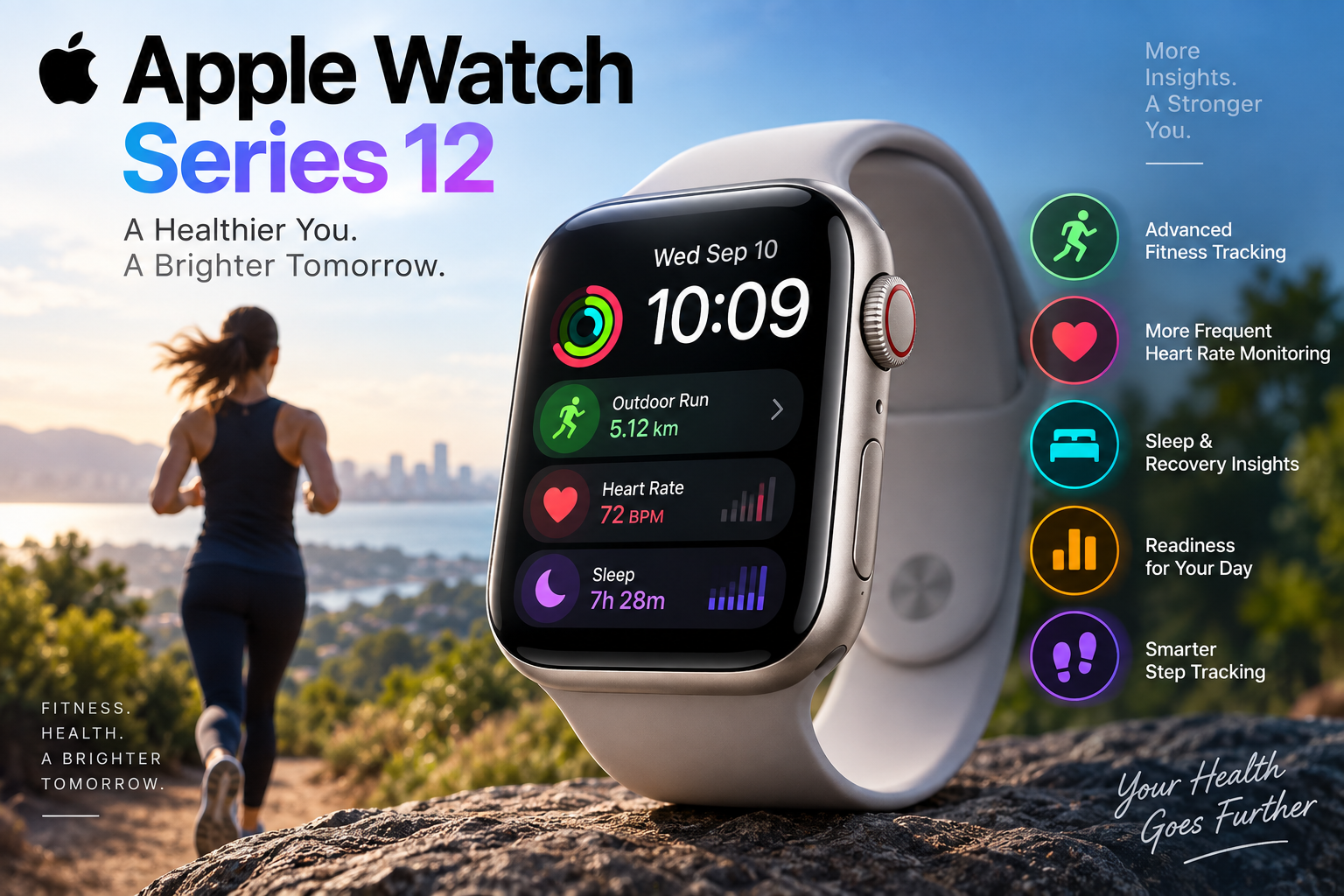
Announced on September 9, 2026, the new smartwatch introduces an updated Health Sensing System built around new optical and electrical heart sensors and Apple’s S11 chip. The company says the system enables more frequent heart-rate and heart-rate variability measurements, while a new readiness feature is designed to help users understand how prepared their bodies may be for the day ahead.
The launch reflects a broader shift in wearable technology. Smartwatches are increasingly moving beyond simple step counts and workout timers toward tools that combine activity, sleep, cardiovascular measurements, and recovery information into a broader picture of personal fitness.
A New Focus on Readiness
One of the headline fitness additions to Apple Watch Series 12 is Readiness.
The feature uses information including recent activity, training load, sleep data, and physiological measurements to produce a score from 0 to 10. Apple says the result is intended to help users understand their capacity for the day and decide whether to push ahead with planned activity or prioritize recovery.
The score can change as new information becomes available during the day.
That approach represents a different way of thinking about fitness tracking. Instead of simply asking how much exercise someone completed, the watch is also attempting to answer a broader question: how prepared is the body for additional activity?
This fits into the wider development of The Complete Guide to Physical Activity and Exercise, where exercise is viewed as part of a broader pattern involving intensity, consistency, recovery, and everyday movement.
Heart Rate Tracking Gets More Frequent
Apple Watch Series 12 also brings changes to heart-rate monitoring.
Apple says the new Health Sensing System measures heart rate every five seconds throughout the day. The company has also increased the frequency of heart-rate variability measurements, with HRV available as often as every five minutes.
Heart-rate variability can provide information related to changes in the time between heartbeats. Apple is using separate HRV measurements for recovery-related signals and broader health insights.
The watch can compare overnight recovery HRV against an individual’s personal baseline, providing additional context rather than presenting a single measurement in isolation.
For people who use wearables during both workouts and rest periods, this creates a more continuous stream of information.
Recovery Becomes a Bigger Part of Fitness Tracking
The emphasis on HRV and readiness also shows how recovery has become increasingly important in consumer fitness technology.
Traditional fitness tracking often focused on measurable activity: steps taken, calories burned, distance covered, or minutes exercised. Newer systems are increasingly interested in what happens between workouts.
Sleep, resting measurements, training load, and physiological changes can all provide additional context around how someone responds to exercise.
The broader trend is explored in Recovery Tracking Becomes One of Fitness’s Biggest Trends, as wearable companies increasingly build tools designed to help users balance training and recovery.
Apple’s new Readiness feature fits naturally into that movement.
Rather than treating every day as an opportunity to maximize activity, the system can indicate when recovery may deserve greater attention.
More Accurate Step Tracking
Steps remain one of the simplest and most widely used fitness measurements, and Apple is also updating this area.
Apple says Series 12 uses a redesigned pedometer model and machine-learning algorithms to improve distance measurements during indoor walking and running workouts. The S11 chip also supports more accurate step counting throughout the day.
The company is introducing a dedicated Steps complication, allowing users to see their current step count directly from the watch face.
The update is particularly interesting because step counting remains one of the easiest ways for people to monitor everyday movement.
At the same time, a growing body of fitness research has challenged the idea that everyone needs to reach one universal daily target. Do You Really Need 10,000 Steps a Day? What the Evidence Actually Says examines why the relationship between daily steps and health is more nuanced than a single number suggests.
Workout Tracking Gets a Battery Boost
Fitness tracking is only useful when people can comfortably wear the device during their workouts.
Apple Watch Series 12 maintains up to 24 hours of everyday battery life, while Apple says workout battery life has increased to as much as 10 hours for an outdoor workout.
Charging has also become faster. Apple says 15 minutes of charging can provide up to 12 hours of additional battery life.
For active users, faster charging can make a practical difference. A short charging session before bed, before a workout, or while getting ready in the morning can reduce the need to leave the watch off for extended periods.
Longer workout battery life can also make the device more useful for people whose training sessions extend beyond ordinary daily exercise.
The Health App Is Becoming More Intelligent
Apple Watch Series 12 does not operate independently of Apple’s broader health ecosystem.
The company is redesigning the Health app on iPhone with new sections focused on insights and longevity. Apple says Apple Intelligence will help analyze health information and surface more relevant information throughout the day.
The new Longevity section includes a Health Age feature that compares certain health-related measurements with a user’s actual age.
Apple is also adding movement evaluations that can assess areas such as flexibility, strength, and balance using the iPhone’s camera alongside information from Apple Watch.
This represents a broader shift from collecting health data to interpreting it.
A smartwatch can gather thousands of measurements, but raw numbers are not always useful without context. Intelligent summaries can potentially make that information easier for ordinary users to understand.
Wearable Technology Is Moving Beyond Basic Tracking
The Series 12 launch arrives as wearable technology becomes more sophisticated.
Modern watches can track movement, heart rate, sleep, workouts, and other physiological measurements while remaining small enough to wear throughout the day.
The evolution is part of the broader Wearable Fitness Tech 2026 Trend, with manufacturers increasingly competing on sensors, software, AI-powered interpretation, and personalized feedback.
The emphasis is gradually shifting from simply recording what happened to helping users understand what the data might mean.
That distinction is important.
Recording that someone exercised for 45 minutes provides one piece of information. Combining that activity with sleep, HRV, recent training load, and other measurements can provide a more complete picture of the person’s recent routine.
Audio and AI Features Expand the Watch’s Role
Although fitness and health are major parts of the Series 12 update, Apple is also adding artificial intelligence features that extend beyond exercise.
The S11 chip supports new Audio Intelligence capabilities, while watchOS 27 brings Siri AI features to supported Apple Watch models.
Apple says Series 12 can use its microphone and AI capabilities to help users stay aware of important sounds and remember moments from conversations. Some of these capabilities depend on the iPhone and Apple’s broader AI infrastructure.
The inclusion of these features illustrates how smartwatches are becoming general-purpose wearable computers rather than fitness devices alone.
A single device can now serve as a workout tracker, health monitor, communication tool, navigation assistant, notification screen, and AI interface.
The Importance of Personal Baselines
One of the more significant aspects of the new health features is Apple’s emphasis on personal baselines.
Fitness measurements can vary considerably between individuals. A heart-rate or HRV measurement that is normal for one person may be different from another person’s typical range.
Comparing measurements with an individual’s own historical data can therefore provide more useful context than relying entirely on population-wide reference points.
Apple’s recovery HRV feature uses a personal baseline for overnight analysis, while Readiness also draws on recent personal data.
This approach reflects a larger movement in digital fitness toward personalization.
Instead of asking whether a person matches an average, technology can increasingly examine how that person’s current measurements compare with their own recent patterns.
What the New Features Mean for Everyday Exercise
For casual users, the most useful changes may not be the most technically advanced ones.
More accurate step tracking can make everyday movement easier to monitor. Better heart-rate measurements can provide more detailed workout information. Readiness can give users another way to think about whether they want to train hard or take an easier day.
For regular exercisers, the combination of training load, sleep, HRV, and readiness may be more useful because these measurements can be considered together.
However, wearable data should still be treated as information rather than a substitute for professional medical advice. Health metrics can be affected by many factors, and a smartwatch cannot provide a complete picture of a person’s health.
A More Complete Picture of Fitness
Apple Watch Series 12 shows how the definition of fitness tracking is changing.
The focus is no longer limited to counting steps or recording workouts. Newer wearable systems are attempting to connect activity with recovery, sleep, heart-rate patterns, and longer-term health information.
Apple’s new Health Sensing System, higher-frequency HRV measurements, Readiness feature, improved step tracking, and redesigned Health app all fit into that broader direction.
The most important development may therefore be the move toward context. Instead of giving users another collection of isolated numbers, the Series 12 is designed to connect different measurements and turn them into a more understandable picture of how activity and recovery fit into everyday life.
As wearable technology continues to evolve, that balance between measuring more and helping users understand more could become one of the defining features of the next generation of fitness devices.
Continue Reading
Similar Posts
Walking Faster May Matter More Than Hitting 10,000 Steps, New Study Finds
A large U.S. study found that even relatively short periods of fast walking were associated with lower mortality risk, while newer research has also found that higher stepping intensity can be associated with better cardiovascular outcomes.
Read article
Just 3 Minutes of Intense Exercise Could Trigger Powerful Health-Related Changes, Study Finds
That does not mean three minutes of sprinting has been proven to replace a longer workout. Instead, the findings offer a closer look at why intense exercise may produce such a rapid and wide-ranging biological response.
Read article
Is Walking Enough Exercise? New Research Reopens the Fitness Debate
The study does not prove that walking faster or taking a particular number of steps prevents death. It does, however, add to a growing body of evidence suggesting that there is no single magic step count or perfect form of exercise.
Read article

Join 10,000+ Readers Building Healthier Habits
Get actionable wellness tips every week plus our newest articles delivered straight to your inbox.