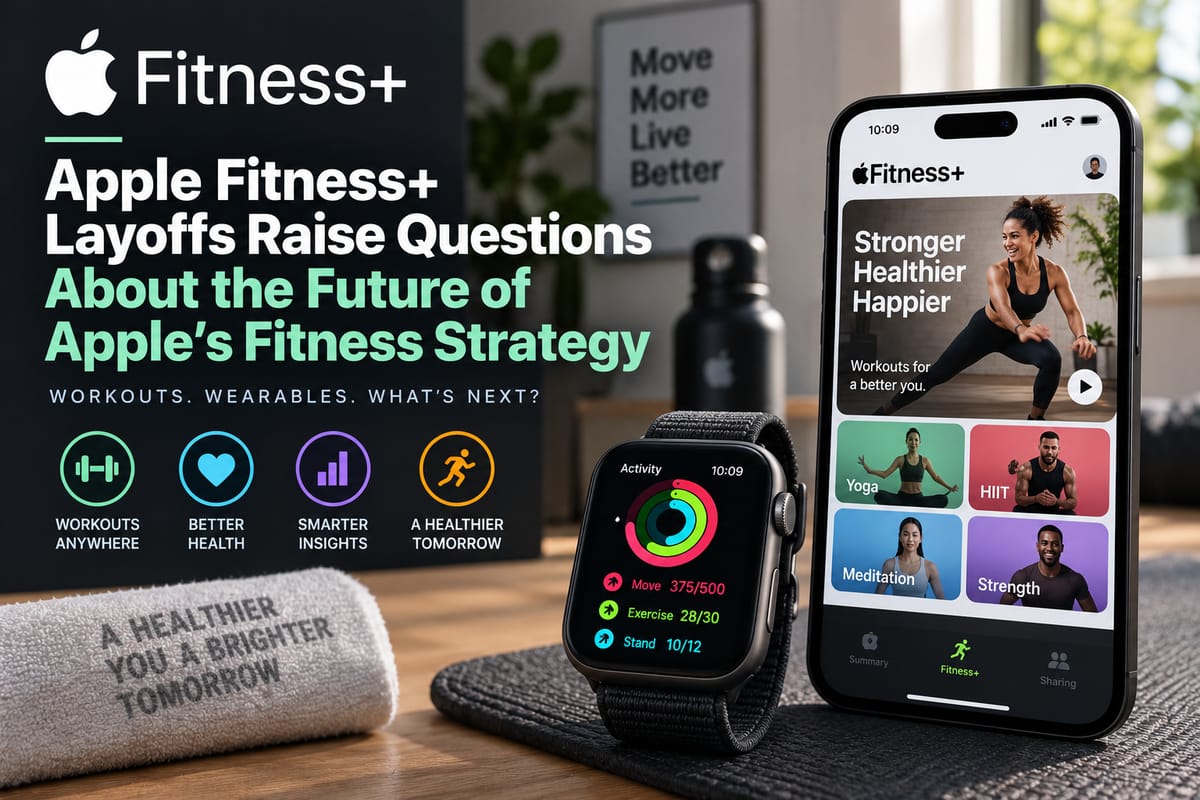

Apple Fitness+ Layoffs Raise Questions About the Future of Apple’s Fitness Strategy
Apple Fitness+ is facing fresh questions about its future after Apple reportedly cut a small number of jobs within the service, including roles connected to its audio programming. The reductions come at an interesting moment for Apple’s broader health and fitness strategy, as the company is simultaneously investing heavily in Apple Watch, health tracking and Apple Intelligence.
According to reporting from Bloomberg’s Mark Gurman, the recent cuts affected a handful of employees on the Fitness+ team, including people working on audio experiences such as Time to Walk and Time to Run. The features are not being discontinued, but new audio content is expected to arrive less frequently.
That combination — targeted staffing reductions alongside major investments in health technology — raises an important question: Is Apple moving away from Fitness+ as a standalone fitness subscription, or is it preparing to make the service part of a broader health ecosystem?
The Fitness+ Cuts Are Small, but the Timing Matters
The reported layoffs do not amount to a large-scale shutdown of Fitness+. The service continues to offer guided workouts, meditation, programs and audio experiences across Apple’s device ecosystem.
However, the timing makes the development noteworthy.
Apple spent years building Fitness+ into a major component of its health and wellness offering. The service launched with professionally produced workouts designed to work closely with Apple Watch, allowing users to see metrics such as heart rate and calories while exercising.
In 2025, Apple also expanded Fitness+ into 28 additional markets, bringing the service to 49 countries and regions and adding digitally dubbed content in languages including Spanish, German and Japanese.
Earlier in 2026, Apple continued adding programming. New offerings included multiweek workout programs, Artist Spotlight sessions and additional Time to Walk episodes.
Against that backdrop, reductions in part of the Fitness+ workforce suggest that Apple may be reassessing how much content the service needs to produce and which parts of the experience deserve the most investment.
Audio Content Could Become Less Central
The reported cuts appear particularly significant for Fitness+’s audio side.
Time to Walk and Time to Run occupy a different position from traditional Fitness+ video workouts. Users can listen to guided experiences through Apple Watch while walking or running without having to watch a screen.
That makes them useful for people who want technology to support exercise without becoming the focus of the workout.
If Apple reduces the frequency of new audio releases, the change could indicate that the company sees greater value in personalized, data-driven fitness experiences than in continually producing large amounts of original content.
Apple has not announced that Time to Walk or Time to Run are being discontinued. Current reporting indicates that new episodes will continue, but potentially at a slower pace.
That distinction matters. A reduction in production does not necessarily mean Apple is abandoning audio fitness. It could instead mean that Apple is adjusting the economics of content production.
Apple’s Health Strategy Is Moving in a Broader Direction
The most important development may actually be happening outside Fitness+.
In September, Apple unveiled a significantly expanded health experience built around Apple Watch, iPhone and Apple Intelligence. The new Apple Watch health sensing system adds higher-frequency heart-rate and heart-rate-variability measurements, along with a new readiness experience.
At the same time, Apple announced a redesigned Health app that brings health and fitness information together in a more comprehensive way.
The app’s new Insights experience can surface information about areas including heart health, sleep, readiness, fitness and vital signs. Apple is also introducing a Longevity tab designed to analyze longer-term health information and provide context around areas such as movement, sleep, cardiovascular health and metabolic health.
This represents a broader concept of digital fitness.
Rather than simply giving people a library of workouts, Apple can increasingly use the Apple Watch and iPhone to understand activity patterns, recovery indicators and other health measurements.
For users, that could eventually make the distinction between “fitness app” and “health platform” less important.
AI Could Change What a Fitness Subscription Looks Like
Artificial intelligence is another piece of the strategy.
Apple says Apple Intelligence is being integrated into the redesigned Health app to provide more personalized and understandable insights from a user’s health and fitness information. The company is positioning the technology around guidance and context rather than simply presenting users with raw measurements.
That could change what consumers expect from a fitness service.
A traditional fitness platform primarily answers the question: What workout should I do?
An AI-powered health platform can potentially address a much wider set of questions:
- How active have I been recently?
- How is my recovery trending?
- Should today’s workout be easier or harder?
- Am I consistently getting enough movement?
- How are my sleep and activity patterns changing?
- Which habits appear to be helping me stay active?
The underlying trend is already visible across the fitness industry. People increasingly use smartphones, wearables and apps to combine workout guidance with tracking and personalized feedback.
For a broader look at this shift, see Mobile Fitness Apps Continue to Transform At-Home Exercise.
Wearables May Be More Important to Apple Than Workout Videos
Apple’s hardware strategy also provides context for the Fitness+ changes.
The Apple Watch remains central to the company’s health ambitions. Apple’s latest health announcements place significant emphasis on sensing, readiness, heart-rate data, movement evaluations and long-term health insights.
That suggests Apple’s competitive advantage may increasingly come from the combination of hardware, software and personal data, rather than from the size of its workout-video library alone.
This is part of a much larger movement in the fitness industry. Wearables can continuously collect information that traditional workout platforms cannot easily provide.
Our guide to the Wearable Fitness Tech 2026 Trend explores how devices are becoming increasingly important to the way people monitor exercise, recovery and everyday activity.
For Apple, that creates an interesting strategic possibility. Fitness+ could become less about being a standalone Netflix-style library of fitness classes and more about serving as one layer of a connected health experience.
Apple Has Already Been Expanding Fitness Beyond Traditional Workouts
The company’s recent Fitness+ programming also points toward a broader definition of fitness.
In June 2026, Apple introduced Strong Through Menopause, a three-week program combining Yoga and Strength workouts for users navigating perimenopause and menopause. Apple also added a new Time to Walk episode focused on that subject.
The move illustrates how fitness programming can overlap with different stages of health and life.
That could become increasingly important as Apple connects Fitness+, Health and Apple Watch data more closely.
Instead of treating exercise as an isolated activity, the company can position movement as part of a larger system involving sleep, cardiovascular health, mobility, nutrition and long-term wellbeing.
That approach also aligns with the broader principle that effective fitness does not necessarily require long or intense workouts every day. Everyday movement matters too. Strategies for reducing sedentary behavior and adding more movement to everyday life can complement structured exercise programs.
What the Layoffs Could Mean for Fitness+
Several possibilities remain open.
One is that Apple is simply reducing costs in an area where content production has become less efficient. Fitness videos and audio programming require trainers, producers, editors and other creative staff, and not every piece of content necessarily produces the same value for subscribers.
Another possibility is that Apple is changing the role Fitness+ plays within its ecosystem.
If health insights, personalized recommendations and wearable-based coaching become increasingly important, Apple may have less reason to keep expanding Fitness+ through large quantities of new content.
There is also the possibility of restructuring rather than retreat.
A smaller content operation could allow Apple to concentrate on the workout categories, programs and experiences that receive the strongest engagement while putting more resources into personalization and health technology.
Importantly, the available reporting does not establish that Apple has decided to shut down Fitness+ or definitively merge it into another service. Reports about a possible longer-term restructuring should therefore be treated as speculation rather than an announced product strategy.
The Bigger Question Is Whether Fitness+ Still Needs to Stand Alone
Apple’s health ambitions have become considerably broader than they were when Fitness+ launched.
The company now has wearable sensors, an expanding Health app, Apple Intelligence, personalized health insights and a growing collection of exercise and wellness experiences.
That creates an unusual strategic situation.
Fitness+ helped establish Apple as a serious player in digital fitness, but Apple’s newer health capabilities could eventually make the underlying technology more important than the subscription’s original workout-library model.
For consumers, that could mean a future in which fitness guidance becomes increasingly integrated into the devices and apps they already use.
For Apple, the challenge will be deciding how much original fitness content is necessary when artificial intelligence, wearable sensors and personalized health data can potentially provide a different kind of value.
The reported Fitness+ layoffs do not answer that question. But they arrive at a moment when Apple’s fitness strategy appears to be evolving from a service centered on workouts toward a much broader health and wellness ecosystem. The direction of that transition will become clearer as Apple continues developing the Health app, Apple Watch and its AI-powered health features.
Continue Reading
Similar Posts

HHS Launches $10 Million Presidential Fitness Challenge for Schools and Youth Programs
Announced October 1 at Westlake High School in Austin, Texas, the initiative is designed to encourage organizations to implement the revived Presidential Fitness Test while creating positive experiences that can help children develop long-term exercise habits.
Read article
Peloton Tread Flex Launches October 1 as AI-Powered Running Enters a New Phase
Together, the hardware and software changes signal a broader shift in how connected fitness equipment can support runners. Instead of simply displaying workouts, newer machines are increasingly designed to interpret performance data and adapt the training experience around the individual.
Read article
Retatrutide Weight-Loss Results Put Exercise and Muscle Preservation Back in Focus
Those results make retatrutide an important development in obesity medicine. They also reinforce a broader lesson about weight management: **a successful outcome cannot be measured by the number on the scale alone.**
Read article

Join 10,000+ Readers Building Healthier Habits
Get actionable wellness tips every week plus our newest articles delivered straight to your inbox.